Most Energy Efficient 65-Inch TVs UK 2026
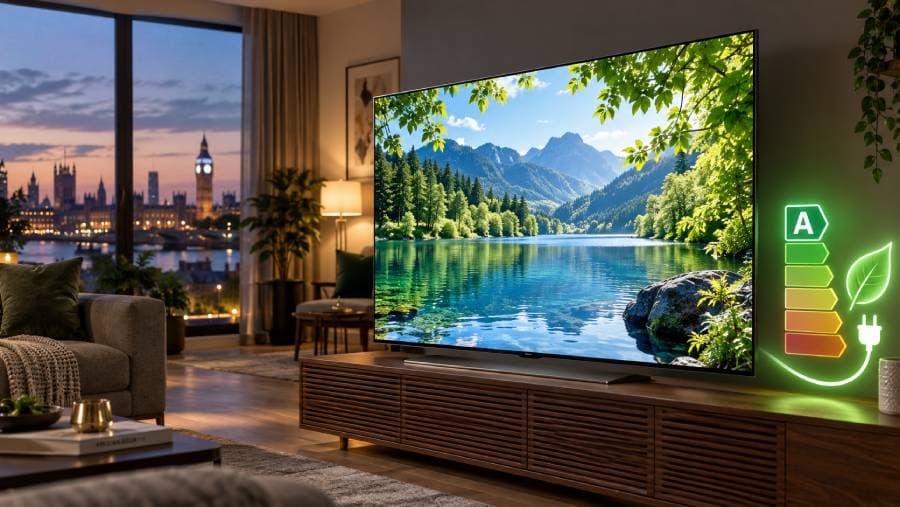
Every 65-inch TV on sale in the UK right now carries a D, E, F or G energy rating — not one reaches A, B or C. That is not a typo and it is not these four TVs underperforming; it is a screen-size problem built into the EU/UK energy label itself, which rates 65-inch sets far more harshly than the 43-inch and 50-inch models that dominate the A-to-C bands. Once you know that, the real question changes from "which 65-inch TV is A-rated" (none is) to "which of the sets I can actually buy right now draws the least power, and what am I giving up to get it."
We pulled the official EU/UK energy-label figures — the SDR and HDR wattage every 65-inch TV must publish — for every set we could verify as genuinely new and in stock on Amazon UK, and ranked four real contenders by that number rather than by marketing copy. Two better-rated sets exist (both Energy Class D, the best available at this size) but neither could be verified as an Amazon UK listing, so they sit in the buying-context section below rather than the picks themselves.
- TCL 65C7L-UK — Best overall efficiency pick, Energy Class E, from £1,199. Check price on Amazon UK
- TCL 65P8L-UK — Best budget efficient pick, Energy Class E, from £849. Check price on Amazon UK
- Hisense 65U7QTUK — Best mid-tier Mini-LED, Energy Class E, from £749. Check price on Amazon UK
- LG OLED65G62LW — Most efficient OLED, Energy Class E, from £2,799. Check price on Amazon UK
All four are genuinely current 2025–2026 models with no newer replacement already on sale, and all four were checked against Amazon UK's own live listing data before being included. Read on for how we ranked them, the full comparison, and the buying context that explains why "most efficient" at 65 inches looks so different from the same claim at 43 inches.
What makes a great product in the 65-inch TV category in 2026
Before comparing individual sets, it helps to understand what the energy label on a 65-inch TV is actually measuring, because it is stricter — and structured differently — than most shoppers expect.
- The label shows two numbers, not one. Every TV sold in the UK and EU must publish its power draw in both SDR (standard dynamic range, the mode most broadcast TV and older streaming content uses) and HDR (high dynamic range, used by most 4K streaming and UHD Blu-ray) [2]. The two figures are usually very different, and the letter grade on the front of the label is based on the SDR figure alone.
- The number is the wattage. The label states consumption in kWh per 1,000 hours of use, which happens to be numerically identical to the average wattage the panel draws while displaying that kind of content. A TV rated "85 kWh/1000h SDR" is drawing roughly 85 watts in typical SDR viewing — a genuinely comparable, non-marketing number across every brand.
- HDR draws far more power than SDR, on every set we checked. The four TVs here range from roughly 1.1x to nearly 3.5x more power in HDR mode than in SDR mode, because HDR asks the backlight (or, for OLED, the individual pixels) to hit much higher peak brightness. A household that watches mostly HDR streaming will use noticeably more electricity than the SDR figure on the box suggests.
- The 2021 rescaling made large TVs look worse, not better, than before. The old A+++ to D scale was replaced with a stricter A-to-G scale specifically because almost every TV was clustering at the top of the old one. Large, bright, high-refresh-rate panels — exactly what a 65-inch set in 2026 tends to be — land disproportionately in the D-to-G range under the new scale, regardless of brand.
- Screen size and peak brightness matter more than panel technology. It is a common assumption that OLED is automatically more efficient than LED/QLED because individual pixels switch off for true black. That holds for genuinely dark content, but a bright, colourful scene pushes an OLED panel's per-pixel brightness up sharply, while a well-tuned Mini-LED panel with local dimming can hold a steadier, lower draw across a wider range of content. That is exactly why the LG OLED here has the single best SDR wattage of the four, but by far the worst HDR wattage — a genuine trade-off, not an inconsistency.
With that context, "most efficient" stops meaning "greenest possible choice" and starts meaning something more useful: which currently-available 65-inch TV draws meaningfully less power than its closest rivals, without asking you to compromise on picture quality, features or price more than necessary. That is the test each of the four picks below had to pass.
Introduction
This guide is for anyone replacing or buying their first 65-inch TV in the UK who wants to factor running cost into the decision, without being misled by a specific model's marketing claims about "eco" features. Ofgem's price cap sets the average Direct Debit electricity rate at 26.32p per kWh from October to December 2026 [1], and Which?'s own testing puts the average annual running cost of a 65-to-75-inch TV at around £34.70 a year, based on four hours' daily use plus standby [3]. That is not a huge sum on its own, but it is one of the few ongoing costs of TV ownership you can actually influence at the point of purchase, and the gap between the best and worst 65-inch sets on sale is large enough to matter over a typical seven-to-ten-year ownership span.
The four TVs recommended here were chosen by combining two things: the official EU/UK energy-label wattage for SDR and HDR use, and confirmation that Amazon UK currently lists the exact model as new and in stock, via Amazon's own Creators API rather than a general product search. That second step matters more than it sounds: a 65-inch TV that reviews well and rates well on paper is not a genuinely useful recommendation if it is out of stock, discontinued or only available second-hand by the time you read this. We checked well over a dozen candidate models from eight brands against Amazon UK's live catalogue before settling on these four; several TVs with a better energy rating than any of the four here — including the current best-rated 65-inch TV, TCL's C8L, and a Toshiba equivalent — could not be verified as genuinely available through Amazon UK and are covered in the buying-context section instead, rather than presented as buyable picks we could not actually confirm.
Expect a real trade-off in every recommendation below. The cheapest and most efficient options here are LED- and Mini-LED-based sets from TCL and Hisense, not premium OLED panels — the one OLED that made the cut, LG's G6, earns its place on raw SDR wattage but is both the most expensive TV here and the one with the largest jump in power draw once you switch to HDR content. None of the four is a bad TV chosen purely to hit a number; each is a genuinely well-reviewed, currently-selling 65-inch set that also happens to sit at or near the front of the efficiency pack for its price and panel type. Where a set makes a real compromise — audio hardware, smart-platform choice, HDR power draw — we say so plainly rather than glossing over it, because a TV that saves you a few pounds a year in running costs is not a good buy if it disappoints you every evening.
Top 4 products worth buying – UK 2026
1. TCL 65C7L-UK — Best overall efficiency pick
✅ Pros:
- Energy Class E at 85W SDR, with 1,152 local dimming zones and up to 3,000 nits peak brightness for genuinely bright HDR highlights when you do want it
- Bang & Olufsen-tuned audio and Dolby Atmos support are unusually strong for a TV in this price bracket, reducing the case for an immediate separate soundbar purchase
- 144Hz native refresh rate and Google TV give it a broader use case than a pure budget set — genuinely capable for console gaming and general streaming alike
⛔ Con:
- Its HDR power draw is the highest of the two TCL models here — the same brightness capability that makes HDR content look punchy also means HDR viewing costs noticeably more than the SDR figure suggests
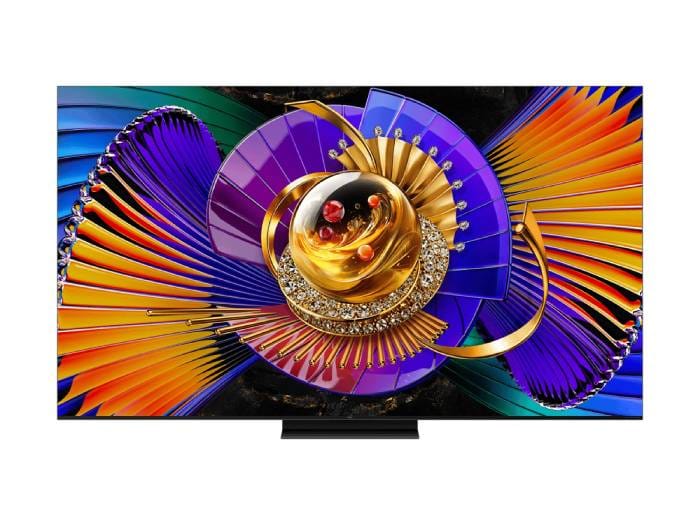
The C7L is TCL's mid-tier 2026 SQD-Mini LED set, and it is the most complete all-rounder of the four TVs in this guide rather than the single lowest-wattage one. Its 85-watt SDR draw ties it with its cheaper sibling, the P8L, but it backs that figure with genuinely higher-end hardware: over a thousand local dimming zones for more precise contrast control [4], a 144Hz panel that handles fast motion and gaming cleanly, and audio tuned by Bang & Olufsen that sounds noticeably fuller than the tinny built-in speakers typical of large, thin TVs [9]. Google TV's smart platform is also a practical advantage if you already use Google's ecosystem for casting or voice control.
The compromise is squarely in HDR mode. Because the panel can push up to 3,000 nits of peak brightness for genuinely striking HDR highlights, its HDR power draw is meaningfully higher than the more modest-brightness Hisense and second TCL model covered below. If you mostly watch SDR broadcast TV and standard-definition streaming, that difference barely matters in practice; if your household watches a lot of HDR-mastered 4K content, it is worth knowing the C7L will draw more power doing so than a set that caps its brightness lower.
This is the pick for someone who wants a genuinely efficient TV without stepping down to the most basic feature set available at 65 inches — a strong all-round set for a mixed household of gaming, streaming and everyday viewing, where the audio quality and dimming-zone count justify paying more than the cheapest efficient option on this list. Buyers who watch almost exclusively HDR content, or who already own a dedicated soundbar and don't need the audio upgrade, are better served by the cheaper P8L below.
2. TCL 65P8L-UK — Best budget efficient pick
✅ Pros:
- The cheapest genuinely efficient 65-inch TV we could verify, at under half the price of the C7L above, while matching its 85W SDR energy rating
- A significantly lower HDR power draw than the C7L (180W versus roughly 300W), because the panel doesn't chase the same extreme peak-brightness numbers
- Still gets 144Hz refresh, VRR support and Google TV, so the lower price doesn't mean stepping back to a genuinely basic smart platform
⛔ Con:
- Onkyo's 2.1-channel sound system is adequate rather than impressive, and most buyers at this price point should budget for a soundbar if audio quality matters to them
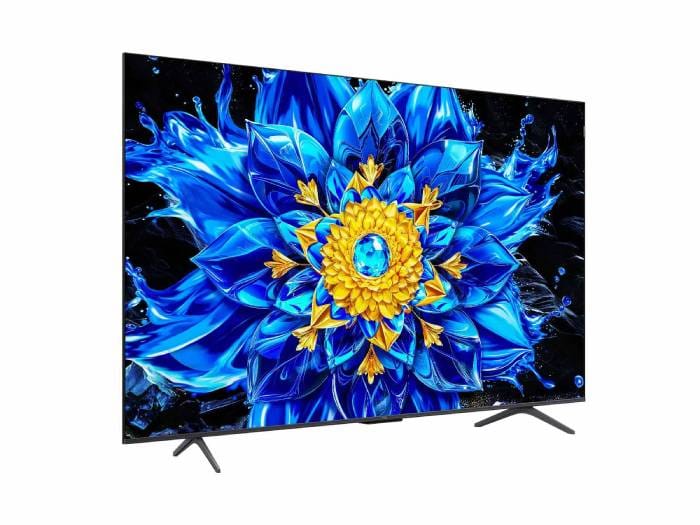
The P8L is TCL's entry point into its 2026 QD-Mini LED range, and it is the strongest value case in this guide: identical 85-watt SDR efficiency to the pricier C7L, at roughly two-thirds of the price [10]. It achieves that partly by not chasing the C7L's extreme peak-brightness numbers, which has the useful side effect of keeping its HDR power draw considerably lower too — a genuinely efficient set in both viewing modes, not just on the headline SDR figure.
What you give up for that price is mainly on the audio and dimming-zone side. The built-in Onkyo 2.1-channel system is a step down from the C7L's Bang & Olufsen tuning, and while HDR10+ support and FreeSync Premium are present [5], the P8L doesn't push the same dimming-zone count or peak brightness as its sibling. For most living rooms, particularly with a soundbar already in place or on the shopping list, none of that is a significant loss relative to the price saving.
This is the right choice for anyone whose priority is genuinely low running cost at the lowest realistic purchase price, rather than the most feature-complete set available — a first 65-inch TV, a bedroom or spare-room upgrade, or simply a household that doesn't want to pay a premium for dimming-zone counts and audio hardware it won't fully use. Buyers who want the fuller feature set and better built-in sound, and are willing to pay more for it, should look at the C7L above instead.
3. Hisense 65U7QTUK — Best mid-tier Mini-LED for efficiency
✅ Pros:
- 84W SDR draw — marginally the lowest of the three LED/Mini-LED sets here — with a genuinely capable Mini-LED panel behind it
- 144Hz Game Mode Pro, Quantum Dot colour and Dolby Atmos give it a strong specification sheet for its price
- VIDAA's smart platform is fast, includes Freely for free live TV without an aerial in supported areas, and supports both Amazon Alexa and its own voice assistant
⛔ Con:
- It is the oldest of the four TVs here — Hisense has not replaced this specific U7 tier for 2026, so it is over a year old, and while no newer model in its line has appeared in our research, that could change during the TV's remaining shelf life
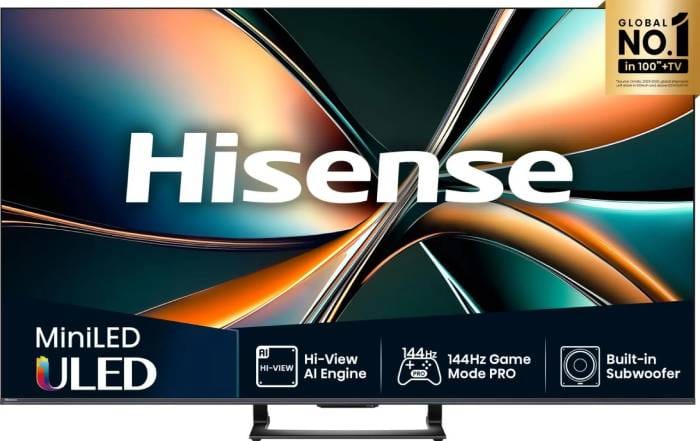
The U7QTUK is Hisense's mid-tier Mini-LED set, and on pure SDR wattage it is marginally the most efficient LED-based TV in this guide, at 84 watts against the two TCL models' 85 watts [11]. That is a small difference in isolation, but combined with genuinely strong hardware for the price — Quantum Dot colour, a 144Hz panel with Hisense's Game Mode Pro, and Dolby Atmos audio support [6] — it makes a compelling case as the pick for buyers who specifically want Mini-LED backlighting technology without paying flagship prices.
The real caveat here is age rather than performance. Unlike the two TCL sets and the LG OLED in this guide, all confirmed 2026 models, the U7QTUK has been on sale since 2025 with no confirmed successor at this specific tier found during our research. It is still genuinely sold new by major UK retailers, not a clearance or end-of-life listing, but a shopper specifically prioritising the newest available technology should know this is the one TV here that isn't a current-year release. VIDAA's platform is also a slightly different proposition to Google TV or LG's webOS if you're used to either of those — it is fast and well-stocked with apps, but the interface and voice-control experience differ enough to be worth trying before you commit if platform familiarity matters to you.
This is the pick for a buyer who wants Mini-LED picture quality and genuinely class-leading LED efficiency at a mid-range price, and isn't concerned about buying last year's model in a tier that clearly hasn't needed refreshing yet. Anyone who specifically wants this year's newest technology, or who is unsure about the VIDAA smart platform, is better served by one of the two 2026 TCL models above.
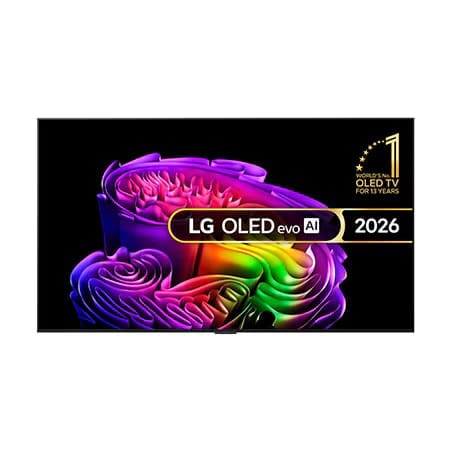
4. LG OLED65G62LW — Most efficient OLED
✅ Pros:
- The lowest SDR wattage of any TV in this guide, at 77.4W, thanks to OLED's per-pixel dimming for the kind of everyday content most SDR viewing consists of
- LG's α11 AI Processor Gen3, 120Hz panel (with VRR up to 165Hz) and Dolby Vision/Atmos support put it well ahead of every other set here on raw picture and gaming performance
- FILMMAKER MODE and webOS's mature smart platform round out a genuinely premium ownership experience, not just a strong number on a spec sheet
⛔ Con:
- Its HDR power draw, at 262W, is by far the highest of the four TVs here — nearly 3.5 times its own SDR figure, and noticeably above the LED/Mini-LED sets even in their HDR mode
The G62LW is LG's 2026 G6-series OLED [7], and it earns its place here on a genuinely interesting technical fact: for standard dynamic range viewing, at 77.4W it draws less power than any LED or Mini-LED TV in this guide, LG's own entry-level LED ranges included [8]. That is OLED's per-pixel switching working as intended — for typical SDR broadcast and streaming content, with plenty of dark and mid-tone material, individual pixels can switch off or dim far more completely than any backlit LED panel can match.
The trade-off shows up the moment you switch to HDR content, and it is a large one. To hit the peak brightness HDR mastering calls for, an OLED panel has to drive every lit pixel much harder, and the G62LW's HDR draw of 262 watts is not just the highest of the four TVs here — it represents by far the biggest jump between a TV's own SDR and HDR figures in this guide. A household that watches mostly SDR content (older streaming libraries, most broadcast TV, non-4K sources) will find this the most efficient TV of the four in daily use; a household that watches predominantly HDR-mastered 4K and UHD content will see that advantage largely disappear, and running costs move closer to, or above, the LED sets above.
This is also, by a wide margin, the most expensive TV in this guide, reflecting OLED panel costs and LG's premium processing and smart-platform hardware rather than anything related to efficiency. It is the right pick for someone who specifically wants OLED's picture quality — genuinely superior black levels, wide viewing angles and per-pixel precision that no LED or Mini-LED set here can match — and who mostly watches SDR content, or is prepared to accept a higher running cost on the HDR content they do watch in exchange for the picture quality. Buyers on a tighter budget, or whose viewing is HDR-heavy, are better served by one of the three LED/Mini-LED sets above, all of which cost meaningfully less to buy and, for HDR-heavy viewing specifically, meaningfully less to run.
Comparison table
| Best for | Exact model | Key specifications | Key strength | Main limitation | Typical UK buyer |
|---|---|---|---|---|---|
| Best overall efficiency | TCL 65C7L-UK | SQD-Mini LED, 85W SDR / ~300W HDR, 1,152 dimming zones, 144Hz, Google TV | Strong all-round hardware (B&O audio, high dimming-zone count) at efficient wattage | Highest HDR draw of the two TCL sets | Mixed-use households wanting a complete set, not just the cheapest one |
| Best budget efficiency | TCL 65P8L-UK | QD-Mini LED, 85W SDR / 180W HDR, 144Hz, VRR, Google TV | Lowest price of the four, matching SDR efficiency with lower HDR draw | Basic 2.1-channel built-in sound | Budget-conscious buyers, secondary rooms, first 65-inch TV |
| Best mid-tier Mini-LED | Hisense 65U7QTUK | Mini-LED, 84W SDR / 180W HDR, 144Hz Game Mode Pro, VIDAA | Marginally the lowest LED SDR wattage here, strong specification for price | Over 12 months old; no confirmed 2026 successor at this tier | Buyers who want Mini-LED and don't need the newest model year |
| Most efficient OLED | LG OLED65G62LW | OLED evo, 77.4W SDR / 262W HDR, 120Hz (VRR 165Hz), webOS | Lowest SDR wattage of all four, best-in-class picture quality | Highest HDR draw by a wide margin; most expensive by far | Picture-quality-first buyers who mostly watch SDR content |
The pattern across all four is consistent: SDR wattage differences between the TVs are modest (77–85W, an 8-watt spread), but HDR wattage differences are dramatic (180–300W, a 120-watt spread). Which of the four is genuinely "most efficient" for your household therefore depends less on the headline SDR number and more on how much of your actual viewing is HDR-mastered content.
TCL 65C7L-UK: Check price on Amazon UK
TCL 65P8L-UK: Check price on Amazon UK
Hisense 65U7QTUK: Check price on Amazon UK
LG OLED65G62LW: Check price on Amazon UK
What to consider before buying
A handful of practical points sit around the headline efficiency numbers and matter just as much to actually owning one of these TVs.
- Why nothing here is rated A, B or C: under the current UK/EU energy label, screens above roughly 55 inches are structurally unable to reach the top bands, because the label's efficiency threshold scales with screen area far more steeply than a large panel's actual power draw does. Currys' own live catalogue of 65-to-74-inch TVs currently shows zero A, B or C-rated models, 11 rated D, 46 rated E, 31 rated F and 7 rated G [12] — meaning even the very best 65-inch TV on the UK market tops out at D. Two D-rated 65-inch sets exist, TCL's C8L and a Toshiba VIDAA model, but neither could be confirmed as a genuinely available new listing on Amazon UK at the time of writing, so they aren't recommended as buyable picks here — worth knowing if you're happy to shop elsewhere and want the single best-rated option available.
- Standby power is close to a non-issue on modern sets. All four TVs here draw around 0.5W in standby, which Which?'s testing puts at roughly £1 a year in electricity [3] — leaving a TV on standby rather than switching it off at the wall makes negligible difference to your bill on any of these models.
- UK warranty and returns vary by retailer, not just brand. Standard UK statutory rights apply regardless of where you buy, but extended warranty terms, delivery/installation options and returns windows differ between Amazon, the big electronics retailers and manufacturer direct stores — always check the specific seller's terms at checkout rather than assuming they match what you've read elsewhere.
- Wall-mounting adds cost most listings don't include. None of these prices include a wall bracket, and a 65-inch panel needs a bracket rated for its weight and VESA mounting pattern — factor in an additional purchase if you're not using a stand.
- Smart-platform choice affects day-to-day use more than most buyers expect. Google TV (both TCL sets), VIDAA (Hisense) and webOS (LG) all cover the major UK streaming and catch-up apps, but the interface, voice-control experience and update cadence differ meaningfully — if you already use one ecosystem heavily (Google, Amazon, or otherwise), it's worth checking how well that platform integrates before assuming they're interchangeable.
- Eco/auto-brightness settings genuinely reduce real-world consumption below the label figure. The published wattage figures are measured under standardised test conditions; in a normally-lit UK living room with a TV's ambient light sensor and eco picture mode left switched on, actual day-to-day draw is typically somewhat lower than the label states, though the SDR-versus-HDR gap described above still applies proportionally.
- Value versus headline specification: peak-brightness and dimming-zone numbers make for eye-catching marketing but, as the C7L-versus-P8L comparison above shows, they correlate closely with higher HDR power draw — a genuinely efficiency-focused buyer should weigh those numbers against running cost, not just picture-quality claims.
Frequently asked questions
Why can't I find an A, B or C-rated 65-inch TV anywhere?
Because none currently exist on the UK market at this screen size. The EU/UK energy label's efficiency thresholds scale with screen area, and a 65-inch panel needs a dramatically lower absolute power draw than a 43-inch or 50-inch set to earn the same letter grade. Currys' own catalogue of 65-to-74-inch TVs shows the best available rating today is D, held by only a small minority of models, with the great majority rated E or F [12]. If genuinely reaching an A-to-C rating matters more to you than screen size, a 43-inch or 50-inch TV will get you there; at 65 inches, D is currently the ceiling.
Should I buy based on the SDR rating or the HDR rating?
Start with whichever mode you actually watch most. The letter grade on the front of every energy label is based on the SDR figure, which is a reasonable proxy if most of your viewing is standard broadcast TV or older streaming content. If your household watches predominantly 4K HDR content — most modern streaming originals, UHD Blu-ray, and current-generation console gaming with HDR enabled — the HDR wattage is the more honest number for your actual running cost, and as this guide shows, the gap between a TV's own SDR and HDR figures can be enormous, particularly for the OLED pick here.
Does turning off features like local dimming or high refresh rate save meaningful electricity?
Reducing peak brightness and enabling a TV's eco or ambient-light-sensor mode has a genuine, measurable effect on real-world power draw, because most of the extra wattage in HDR and high-brightness content comes from driving the backlight or OLED panel harder, not from the refresh-rate or processing electronics themselves. Turning off a 144Hz or 165Hz refresh rate specifically saves comparatively little by contrast — the display panel and backlight dominate a modern TV's power budget far more than its motion-processing hardware.
Is it worth paying more for a more efficient TV just to save on electricity?
On the running-cost saving alone, rarely for its own sake — Which?'s testing puts the average 65-to-75-inch TV's annual running cost at around £34.70 [3], so even a meaningfully more efficient set saves a relatively modest sum each year, and it would take many years to offset a large price difference in purchase cost through electricity savings alone. The more realistic case for prioritising efficiency is when two TVs are otherwise closely matched on price and features, as with the TCL and Hisense picks in this guide — in that situation, choosing the more efficient option costs you nothing extra and genuinely reduces both your electricity use and running cost over the TV's lifetime.
Final verdict
The TCL 65C7L-UK is the strongest overall pick in this guide: matching the lowest LED SDR wattage available, backed by genuinely strong hardware (extensive local dimming, Bang & Olufsen audio, a 144Hz panel) that makes it a complete TV rather than an efficiency-only compromise. Choose it if you want the best balance of running cost, features and price without stepping down to the most basic option or up to OLED pricing.
- TCL 65C7L-UK — best overall efficiency pick, for a complete, well-specified set. Check price on Amazon UK
- TCL 65P8L-UK — choose it for the lowest purchase price alongside matching SDR efficiency, if you're willing to add your own soundbar. Check price on Amazon UK
- Hisense 65U7QTUK — choose it for genuinely class-leading Mini-LED efficiency at a mid-range price, if buying last year's model doesn't concern you. Check price on Amazon UK
- LG OLED65G62LW — choose it if OLED picture quality matters more to you than price, and your viewing is mostly SDR content. Check price on Amazon UK
Whichever you choose, remember that the SDR figure on the box only tells half the story at 65 inches — check which of these four best matches how much HDR content your household actually watches, since that gap is now larger than the difference in purchase price between some of these sets over a typical ownership period. And if the single best-rated 65-inch TV on the UK market matters more to you than same-day Amazon availability, TCL's C8L and a Toshiba VIDAA equivalent both currently hold the better Energy Class D rating — worth a direct search if you're prepared to buy from a different retailer.
By ChoiceWise