Best Follow-Me Drones UK 2026 – Drones That Follow You, No Camera Crew Needed
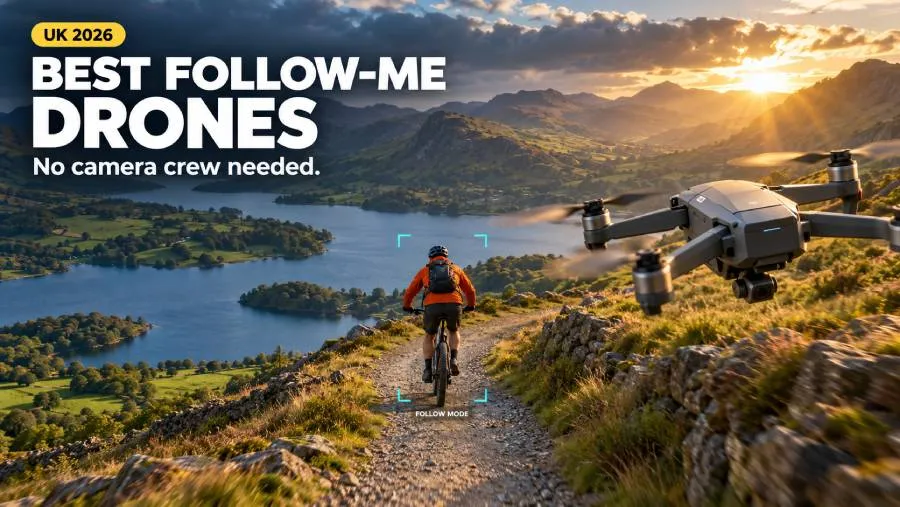
Three people ask the same question in different words. The trail runner wants footage of a Sunday long run without a friend on camera duty. The parent wants the whole family in the frame on a Cornish beach, not one adult holding the phone. The first-time buyer wants a proper camera drone that can lock on to a subject and follow without a second pair of hands on the sticks. A follow-me drone answers all three. This guide, updated for 2026, compares four sub-250 g drones that track a person on their own: a palm-launched selfie drone that needs no controller, a full camera drone with 360-degree tracking and the best sensor of the group, a controller-free flying camera built for sport, and the strongest non-DJI option with a screen controller and the longest flight time here.
- DJI Neo 2 — Best follow-me drone for most people — 👉 Check price on Amazon UK
- DJI Lito X1 — Best image quality and flight time — 👉 Check price on Amazon UK
- HoverAir X1 PRO — Best for runners, cyclists and skiers who want zero piloting — 👉 Check price on Amazon UK
- Potensic Atom 3 — Best non-DJI follow-me drone with a screen controller — 👉 Check price on Amazon UK
👉 Read on for how each one tracks, what it gives up to do so, and which suits your weekends.
Which drone that follows you suits a UK buyer in 2026?
Search for a drone that follows you and the results are a muddle of ten-year-old GPS toys, 8K flagships that cost more than a holiday, and selfie gadgets that cannot see a tree. The useful middle has only settled in the last two years. Every drone in this guide weighs under 250 g, so it sits in the lightest UK category, and every one uses camera-based tracking rather than simply chasing the phone in your pocket. The differences that matter are how it launches, what it can see while it follows, how fast it can keep up, and how long it stays in the air.
If following is a nice-to-have and you mainly want a cheap first drone for holiday scenery, our guide to the best drones for beginners covers lower-cost options. If the point is being in your own footage, keep reading: the four reviews below are ordered from the most spontaneous to the longest-flying, and the buying criteria afterwards explain why the line-up looks the way it does.
Top 4 follow-me drones worth buying – UK 2026
1. DJI Neo 2 — Best follow-me drone for most people
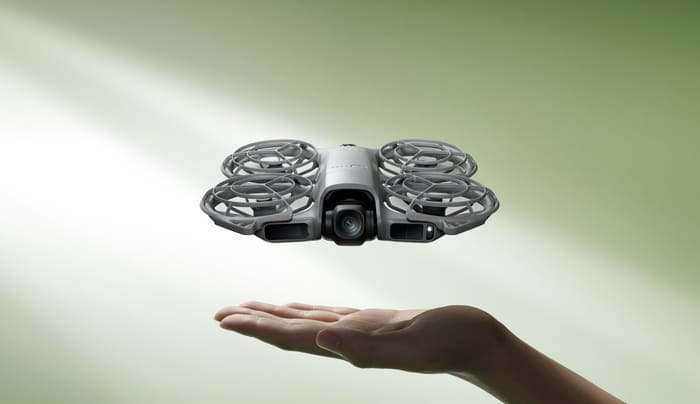
✅ Pros:
- Takes off from and lands back on your palm, with gesture control, so it needs no controller to follow you
- Omnidirectional obstacle sensing plus forward LiDAR, which no other drone at this price offers
- Full-guard 151 g airframe with 49 GB of internal storage, so there is nothing to snap and no card to forget
⛔ Con:
- A 19-minute flight time and a 1/2-inch sensor make it a 4K selfie camera rather than a landscape drone
The Neo 2 is the drone for the parent on the beach and the runner who wants to press one button and go. Everything about it is built around the launch: point it at yourself, press the button, and it lifts off your hand. DJI's specifications put the take-off weight at 151 g, or 160 g with the optional transceiver fitted, with a 1/2-inch 12 MP sensor, 4K at up to 60 fps in the standard aspect and 2.7K vertical video for social posts [1]. The gimbal has two mechanical axes, tilt and roll, which is one fewer than a full camera drone but enough to keep the horizon level while it follows [1].
The standout feature is what it can see while tracking. DJI lists an omnidirectional monocular vision system with a forward-facing LiDAR and a downward infrared sensor, with detection ranges up to 15 m depending on direction [1]. In plain terms, it watches every side while it chases you, rather than only the front. Subject tracking is rated to 12 m/s, which is a fast cyclist rather than a sprinting one, and the drone-only price at launch was £209 [11]. Testers who took it onto mountain-bike trails found that large, clearly visible obstacles were detected reliably and tracking was consistent in open terrain, but fine branches at speed in dense woodland were still missed, so a full run through a tight forest is a risk you take knowingly [15]. One long-term sports tester rated it the tracking drone to beat, in part because you can position it in the sky with hand gestures, lock it with a fist, and carry on running [16].
The compromises are flight time and camera. DJI's own figure is about 19 minutes, dropping to 17 with the propeller guards, and the mountain-bike test measured roughly 17 minutes in practice with a 70-minute recharge, so a day out means spare batteries [1][15]. The 1/2-inch sensor is fine for a well-lit beach or park but it is the smallest here, and reviewers still describe the propeller noise as shrill and loud even after this generation's improvement [15]. The same test noted it working hard to hold position on a gusty day [15]. There is no microSD slot, so the 49 GB internal memory is your only storage [1].
Who should buy it: anyone whose main use is being followed at walking-to-cycling pace in open spaces, who wants the least setup and the most protection around people. Who should skip it: photographers who care about low light or large prints, and anyone planning long flights away from a charger. The compromise you accept is a small sensor and short flights in exchange for the safest, simplest follow-me drone on sale.
2. DJI Lito X1 — Best image quality and flight time in a sub-250 g follow-me drone
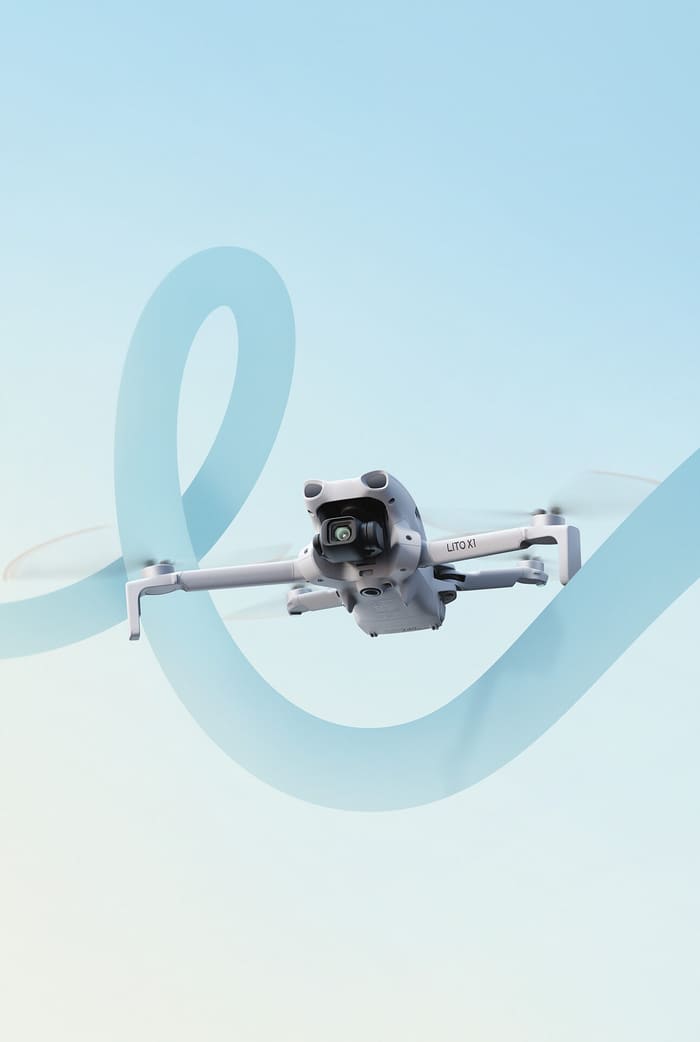
✅ Pros:
- 1/1.3-inch 48 MP sensor with an f/1.7 lens, the best camera of the four for low light and stills
- 36 minutes per battery, or 52 minutes with the Plus battery, so one flight covers a whole session
- Omnidirectional obstacle sensing with forward LiDAR and tracking rated to 12 m/s
⛔ Con:
- A controller-flown drone: no palm launch or gesture control, so it is less spontaneous than the Neo 2 or X1 PRO
The Lito X1 is the pick for the buyer who wants a proper camera drone first and a follow-me drone second. DJI launched it in April 2026 as the higher of two entry-level models, and it weighs approximately 249 g on take-off with its standard battery, just under the threshold that matters in the UK and most of Europe [2]. The sensor is a 1/1.3-inch 48 MP unit behind an f/1.7 lens with a 24 mm equivalent field of view, and it records 4K at up to 100 fps for slow motion with a maximum bitrate of 130 Mbps [2]. Against the 12 MP 1/2-inch sensors in the Neo 2 and X1 PRO, that is the difference between footage for a phone and footage for a large television.
The standout feature for this guide is that you do not give up tracking to get that camera. DJI's specifications list the same omnidirectional monocular vision system as the Neo 2, supplemented by forward-facing LiDAR and a downward infrared sensor, with an effective tracking speed of 12 m/s [2]. ActiveTrack keeps the subject centred while it follows, and the reviewer at Amateur Photographer found it useful for people and vehicles, with the caveat that the sensing does not reliably cover objects directly above the aircraft and should not replace careful flying [12]. Flight time is the other headline: 36 minutes on the standard battery and 52 minutes with the Plus battery in DJI's wind-tunnel figures, with the same reviewer seeing around 25 minutes in mixed use, still a third longer than anything below it in this list [2][12].
The compromise is the way you fly it. The Lito X1 is a conventional folding drone flown from a controller with the DJI Fly app, so ActiveTrack is something you start from a screen after take-off rather than by holding out your hand. That suits a partner filming you, less so a runner who wants to launch mid-stride. The f/1.7 aperture is fixed, which means ND filters are close to essential for bright daylight video and they are sold separately [12]. Internal storage is 42 GB with a microSD slot for more, transmission reaches 8 km on the European standard, and wind resistance is 10.7 m/s [2]. It carries a C0/C1 class mark, which the UK treats as UK0/UK1 equivalent [2][10].
Who should buy it: the person who wants one drone for holiday landscapes, family video and the occasional follow, and who is happy to learn a controller. Who should skip it: anyone who wants to launch from a hand without a screen, or who will fly mostly among trees. The compromise you accept is a little more setup for a much better camera and roughly double the airtime of the selfie drones.
3. HoverAir X1 PRO — Best for runners, cyclists and skiers who want zero piloting
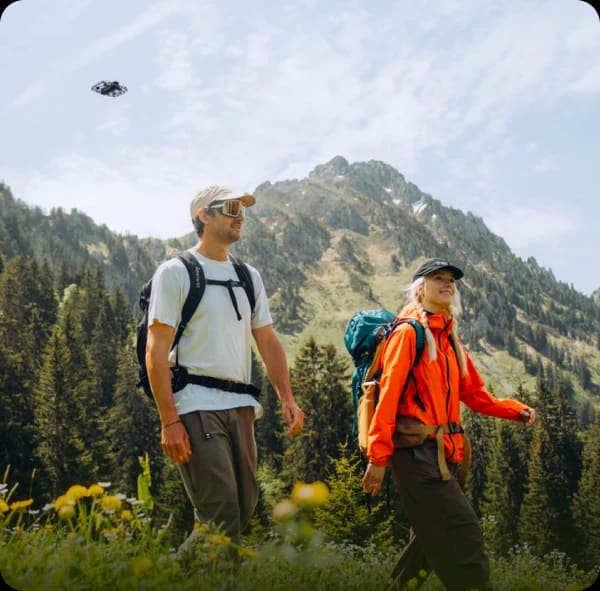
✅ Pros:
- Follows at up to 42 km/h with dedicated Cycling and Ski modes, faster than any DJI drone here
- 192 g, fully enclosed propellers, launches and lands from your palm and folds to pocket size
- Works with no controller at all: every mode is a single button press on the aircraft
⛔ Con:
- Rear-only proximity sensing and a 16-minute flight time, so it needs open trails and spare batteries
HoverAir does not call the X1 PRO a drone at all; it calls it a self-flying camera, and the distinction is the whole point. There is no controller in the box and none needed: you raise it to eye level, press one button to choose a mode, and it launches, films and returns to your palm. HoverAir announced the X1 PRO and its 8K sibling in August 2024 with the PRO at 191.5 g, 4K video at up to 60 fps through a 104-degree lens, and a maximum follow speed of 42 km/h with tracking bursts to 60 km/h [3]. The company's own specification table lists a 1/2-inch sensor, 12 MP stills, a two-axis gimbal with electronic stabilisation, 16 minutes of flight and Level 5 wind resistance of 10.7 m/s [4].
The standout feature is that follow speed paired with modes built for sport. DJI's drones track to 12 m/s, or 43 km/h, on paper, but the X1 PRO's Cycling and Ski modes, plus Follow, Dolly Track, Angle Track, Orbit and a dozen more, are chosen on the aircraft and framed for a moving athlete rather than a walking subject [4]. The enclosed HEM frame is the other reason it suits sport: a clipped branch is a bounce rather than a broken propeller, and the aircraft can operate down to minus 20 °C with the Thermo battery for a ski week [3]. A wearable Beacon and joystick set is an optional accessory for precise placement or manual control [3].
The compromise is what it cannot see. The specification sheet lists obstacle avoidance as a rear time-of-flight sensor only, with the PROMAX adding a rear vision sensor; there is no forward or side sensing on either [4]. HoverAir's philosophy is that a 192 g aircraft following your exact path will fit through any gap you fit through, which holds on a fire road and less so on a switchback. Flight time is 16 minutes, the shortest here, and the 1/2-inch sensor matches the Neo 2 rather than the Lito X1 [4]. It is not waterproof, and HoverAir advises keeping at least 1.5 m above water when flying over it [4].
Who should buy it: solo runners, road and gravel cyclists, skiers and anyone who wants footage of themselves without ever touching a controller. Who should skip it: mountain bikers on tight, wooded singletrack, and anyone who wants a drone to fly scenery as well as follow. The compromise you accept is the least sensing and the shortest flights in exchange for the fastest, most hands-off tracking of the group.
4. Potensic Atom 3 — Best non-DJI follow-me drone with a screen controller
✅ Pros:
- 40 minutes on the standard battery and 50 with the extended battery, the longest flights in this guide
- 1/1.3-inch 50 MP sensor with 4K/60 HDR video, matching the Lito X1's sensor class
- Comes with the PTD 2 controller with its own 5.5-inch screen, plus 16 km transmission and built-in Remote ID
⛔ Con:
- No obstacle sensing at all, so its tracking modes need open ground and a watchful pilot
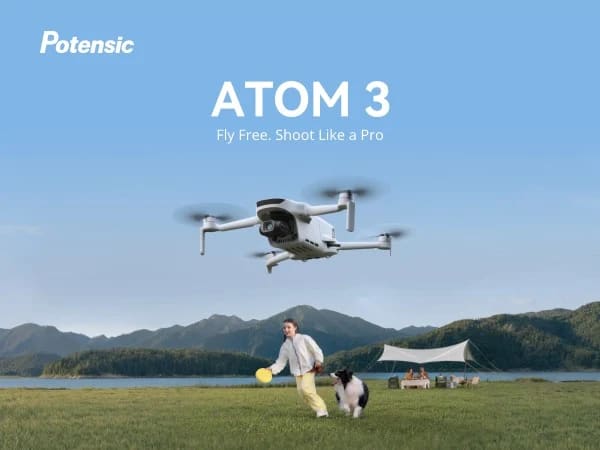
The Atom 3 is the answer for the buyer who wants a full camera drone with tracking and would rather not buy DJI, or who values flight time above everything. Potensic released it in June 2026 as the new top of its Atom range, and its own page lists a take-off weight under 249 g, an upgraded 1/1.3-inch sensor with 50 MP stills and 4K/60 HDR video, and a triple-band transmission system rated to 16 km with a 1080p/60 live feed [5]. Flight time is 40 minutes on the standard battery or 50 with the extended-range battery, which is the longest single flight here by a clear margin, and the drone carries built-in Remote ID [5]. The kit linked below is the Standard Kit with the RC PTD 2 controller, whose 5.5-inch 900-nit screen means you fly without clipping in a phone; UK launch pricing was £339.99 for the phone-controller kit, £449.99 for the Fly More kit and £469.99 for this PTD 2 kit [13].
The standout feature is AI Tracking 2.0 paired with that endurance. Potensic's store lists Follow, Parallel and Spotlight tracking modes alongside Drift, Spin Ascend and Dolly Zoom cinematic moves, and the product page adds a low-altitude tracking option below 4 m that is enabled only with propeller guards fitted [5][6]. Where the Lito X1 gives you 36 minutes and the selfie drones 16 to 19, the Atom 3 gives you a full afternoon on two batteries, and a first-flight review found the 4K/60 footage and P-Log profile competitive, with the caution that JPEG stills came out oversaturated and over-smoothed, so shoot RAW for photographs [14].
The compromise is a big one for a follow-me buyer: there is no obstacle sensing of any kind [14]. Every other drone in this guide can at least detect something in its path; the Atom 3 relies entirely on you keeping the tracking path clear, which is fine for a beach, a playing field or a wide bridleway and unwise among trees. Potensic's UK store ships from within the UK, and the standard batteries recharge in about 90 minutes on the parallel hub [5][6].
Who should buy it: the buyer who wants the longest flights, a proper screen controller and a strong camera, and who will use Follow and Parallel modes in open spaces. Who should skip it: anyone who expects the drone to look after itself near obstacles, or who wants the smallest possible bag. The compromise you accept is the absence of sensing in exchange for the best endurance and controller of the four.
What separates a drone that follows you from one that only flies
Every drone here is 4K, foldable and under 250 g. Those words no longer separate a good follow-me drone from a poor one. The criteria below do, and they explain why the four picks look so different from each other.
- How the tracking works. Older follow-me drones followed the GPS position of your phone, which lags, drifts by several metres and cannot see you at all. All four drones here track visually, locking on to a person in the camera frame. DJI calls this ActiveTrack, HoverAir builds it into every flight mode, and Potensic calls it AI Tracking 2.0 with Follow, Parallel and Spotlight variants [1][4][5]. Visual tracking is what lets a drone stay behind you round a bend.
- What it can see while it follows. This is the biggest difference in the group. The Neo 2 and Lito X1 have omnidirectional vision sensing supplemented by forward LiDAR [1][2]. The X1 PRO has a rear proximity sensor only [4]. The Atom 3 has none [14]. Sensing decides where you can safely use Follow mode: open ground suits all four, tree-lined paths suit only the DJI pair, and dense woodland at speed suits none of them [15].
- How it launches. The Neo 2 and X1 PRO take off from your palm and are controlled by gestures or a single button, so you can start a follow mid-run [1][3]. The Lito X1 and Atom 3 are flown from a controller and tracking is started from a screen.
- How fast it can keep up. DJI rates tracking on the Neo 2 and Lito X1 at 12 m/s, about 43 km/h [1][2]. HoverAir quotes 42 km/h with bursts to 60 km/h for the X1 PRO [3]. All are ample for running and most cycling; a fast road descent will outrun any of them.
- How long it flies. Selfie drones sacrifice airtime for size: 19 minutes for the Neo 2 and 16 for the X1 PRO, versus 36 for the Lito X1 and 40 to 50 for the Atom 3 [1][2][4][5].
- Camera size. A 1/1.3-inch sensor, as in the Lito X1 and Atom 3, gathers roughly twice the light of the 1/2-inch sensors in the Neo 2 and X1 PRO, which shows at dusk and in shade [1][2][4][5]. For daytime sport, all four are sharp; for golden-hour landscapes, the two larger sensors win.
- Weight and class. Staying under 250 g keeps every one of these in the UK's lightest category, which allows flying closer to people and in built-up areas that heavier drones must avoid [9].
Comparison table
The decisive differences are sensing, launch method and flight time. The camera gap matters only if you also want landscape footage.
| Best for | Exact model | Key specifications | Key strength | Main limitation | Typical UK buyer |
|---|---|---|---|---|---|
| Most people | DJI Neo 2 | 151 g, 1/2-inch 12 MP, 4K/60, 19 min, omnidirectional sensing + forward LiDAR, tracking 12 m/s, 49 GB | Palm launch, gestures and all-round sensing at the lowest price | Short flights and a small sensor | Family holidays, park runs, first follow-me drone |
| Image quality and airtime | DJI Lito X1 | 249 g, 1/1.3-inch 48 MP f/1.7, 4K/100, 36 min (52 with Plus), omnidirectional sensing + LiDAR, 42 GB + microSD | Best camera and sensing together | Controller-flown; ND filters extra | Traveller who wants scenery and follow shots from one drone |
| Sport without a controller | HoverAir X1 PRO | 192 g, 1/2-inch 12 MP, 4K/60, 16 min, rear sensing only, follow to 42 km/h, Cycling and Ski modes | Fastest, most hands-off tracking with enclosed props | No forward sensing; shortest flights | Runner, road cyclist or skier filming solo |
| Endurance and a screen controller | Potensic Atom 3 | Under 249 g, 1/1.3-inch 50 MP, 4K/60 HDR, 40/50 min, 16 km, PTD 2 screen controller, Remote ID | Longest flights and a full controller in the box | No obstacle sensing | Buyer who wants a non-DJI camera drone with tracking for open spaces |
DJI Neo 2: 👉 Check price on Amazon UK
DJI Lito X1: 👉 Check price on Amazon UK
HoverAir X1 PRO: 👉 Check price on Amazon UK
Potensic Atom 3: 👉 Check price on Amazon UK
What to consider before buying
The reviews above cover how each drone follows. These are the ownership questions that decide whether the purchase works out.
UK drone rules for sub-250 g follow-me drones
- Two IDs, not none. All four drones weigh between 100 g and 250 g and carry a camera, and the Civil Aviation Authority's registration page states that in that band you must get a Flyer ID and an Operator ID [7]. The Flyer ID is a free online theory test valid for five years; the Operator ID costs £12.34 a year, requires you to be 18 or over, and must be labelled on the aircraft [8]. Only drones under 100 g, such as toy-class models, are exempt [7].
- Where the light weight helps. Under the Drone Code, a drone below 250 g may fly closer than 50 m to uninvolved people and over them, and may fly in residential, recreational, commercial and industrial areas that heavier drones must keep 150 m from; flying over crowds is still prohibited and the 120 m height limit applies to everyone [9]. That is what makes a beach or park follow shot lawful with these four and not with a 900 g drone.
- Flight restriction zones. Airports, airfields and spaceports have protected zones you must not enter without permission, and the CAA's map and apps show them [9].
- Class marks. New models sold from 1 January 2026 must carry a UK class mark, and a C0-marked drone such as the Lito X1 or X1 PRO is flown as a UK0 class aircraft [2][4][10]. The Atom 3 ships with built-in Remote ID [5].
- Kits and batteries. A follow session eats a battery quickly on the two selfie drones, so budget for at least one spare. DJI and HoverAir sell Fly More or combo kits with extra batteries and a charging hub; the Atom 3 kit linked here is the Standard Kit with the PTD 2 controller, and Potensic's Fly More kits add two more batteries and a hub [6][13].
- Seller and fulfilment. Amazon listings for drones are often fulfilled by a brand's authorised reseller rather than Amazon itself. Check the live seller, the returns window and whether a UK warranty applies before you buy, because these details change between sellers and were not verified for this guide.
- Storage and filters. The Neo 2 has 49 GB internal memory and no card slot, so plan to offload regularly [1]. The Lito X1 takes microSD but needs ND filters for bright daylight video, sold separately [2][12]. The X1 PRO and Atom 3 both use expandable storage [3][5].
- Weather. None of these is waterproof; HoverAir explicitly advises 1.5 m clearance over water, and every one is rated to roughly 10.7 m/s of wind, which is a brisk British breeze rather than a gale [1][2][4].
- Insurance and privacy. Third-party cover is inexpensive for a drone that flies near people by design, and the Drone Code expects you to respect the privacy of anyone who wanders into your follow shot [9].
- Value against the headline number. At the time of writing in September 2026 the Neo 2 lists at about £215, the Lito X1 at £369, the X1 PRO at £439 and the Atom 3 PTD 2 kit at £469.99 on Amazon UK, so the cheapest and dearest are separated by more than double. Pay the extra only for something you will use: airtime, a controller with a screen, or sport modes.
Frequently asked questions
Do I need to register a follow-me drone under 250 g in the UK?
Yes, for all four drones here. The CAA's rule is that a drone weighing 100 g to under 250 g needs a Flyer ID, and if it has a camera it needs an Operator ID as well [7]. The Flyer ID is a free online test that lasts five years; the Operator ID is £12.34 a year and the number must be labelled on the drone [8]. The under-250 g exemption people remember applies only to drones below 100 g, which none of these is [7].
Can a follow-me drone avoid trees while it tracks me?
Only to a point, and it depends which one. The DJI Neo 2 and Lito X1 have omnidirectional vision sensing with forward LiDAR, and testers found they reliably detect large, clearly visible obstacles in open terrain but still miss fine branches at speed in dense woodland [1][2][15]. The HoverAir X1 PRO senses only behind itself and relies on following your exact path, and the Potensic Atom 3 has no obstacle sensing at all [4][14]. The practical rule is to treat every follow mode as safe on open ground, cautious on tree-lined paths with the DJI pair, and off-limits in tight woods with all of them.
Which is better for cycling, the DJI Neo 2 or the HoverAir X1 PRO?
For road, gravel and open-trail riding, the X1 PRO: it has dedicated Cycling modes, follows at up to 42 km/h with bursts to 60 km/h, and its enclosed frame shrugs off brushes with hedges [3][4]. For mixed riding that passes through trees, the Neo 2: it tracks a little slower at 12 m/s but can see in every direction, and a mountain-bike test rated its tracking consistent in open terrain [1][15]. Both launch from your hand and need no controller. Either way, neither lasts much beyond a quarter of an hour per battery.
How long do these drones fly, and do I need spare batteries?
Manufacturer figures are 19 minutes for the Neo 2, 16 for the X1 PRO, 36 for the Lito X1 and 40 to 50 for the Atom 3 depending on battery, all measured in ideal conditions [1][2][4][5]. Measured flights are shorter: the Neo 2 measured around 17 minutes on the trail and the Lito X1 around 25 minutes in mixed use [12][15]. If you plan more than one follow session in an outing, treat a spare battery as part of the purchase for the two selfie drones. The Lito X1 and Atom 3 will usually cover a session on one charge.
Final verdict
For the parent on the beach and the runner who wants one-button footage, the DJI Neo 2 is the drone to buy: it launches from a hand, watches every direction while it follows, and costs the least of the four [1][11]. The Lito X1 is the choice when the same buyer also wants landscapes and low-light stills, and can accept flying from a controller for a far better camera and twice the airtime [2]. The HoverAir X1 PRO wins for the solo cyclist or skier who never wants to touch a controller and rides in the open, with the fastest follow speed here [3][4]. The Potensic Atom 3 is the pick for the longest flights and a screen controller in the box, provided the tracking is used where nothing stands in its path [5][14].
- DJI Neo 2 — Best follow-me drone for most people — 👉 Check price on Amazon UK
- DJI Lito X1 — Best image quality and flight time — 👉 Check price on Amazon UK
- HoverAir X1 PRO — Best for runners, cyclists and skiers who want zero piloting — 👉 Check price on Amazon UK
- Potensic Atom 3 — Best non-DJI follow-me drone with a screen controller — 👉 Check price on Amazon UK
Whichever you choose, register for your Flyer and Operator IDs before the first flight, label the aircraft, and check the seller's returns terms and what is in the box on the day. Favour the launch method you will use over the specification you will admire.
By ChoiceWise