Best 65-Inch OLED TVs Under £1,500 UK 2026
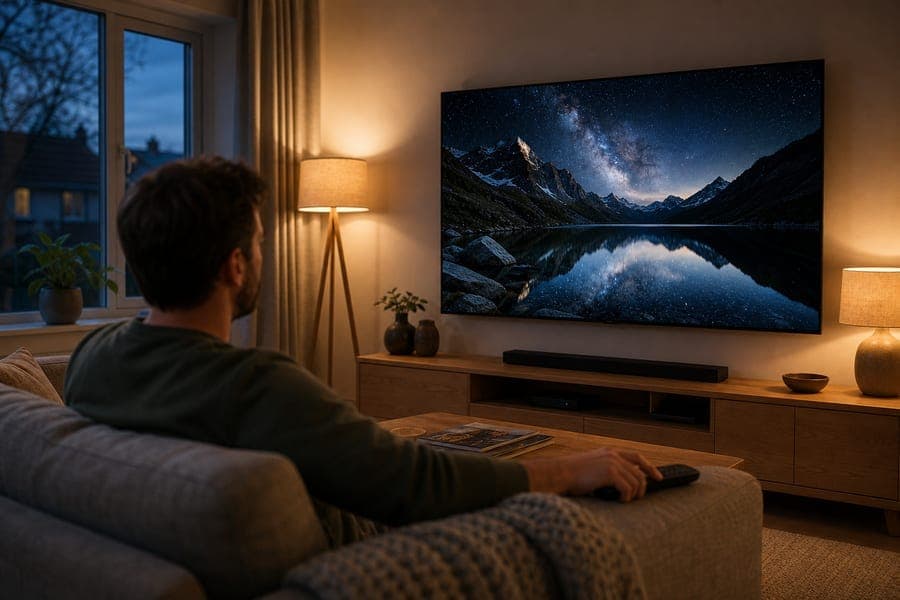
If you want a genuine 65-inch OLED for under £1,500 in the UK right now, you're buying last year's flagship technology at a real discount, not settling for something lesser. 2026's newest OLEDs launch well above £2,000, while the three TVs below use the same panels and near-identical processing as those new flagships, now marked down as their successors take over shelf space. Updated for 2026, here's the shortlist:
- LG C5 65-inch OLED (OLED65C5) — Best overall. Check price on Amazon UK
- Samsung S85F 65-inch OLED (QE65S85F) — Best for brightness and gaming. Check price on Amazon UK
- Sony BRAVIA 8A 65-inch OLED (K-65XR8A) — Best for picture processing. Check price on Amazon UK
Keep reading for the full comparison, what each one gets right, where each one compromises, and which one actually suits your room and your budget.
Introduction
This guide is for anyone who has decided they want OLED — not QLED, not Mini-LED — at 65 inches, and has a real ceiling of around £1,500 to spend in the UK. That's a specific and slightly awkward spot in the market. A 65-inch OLED panel is expensive to manufacture, and brand-new 2026 flagship models from LG, Samsung and Sony all launch at £2,000 or more [11], [12]. Nobody realistically hits £1,500 buying this year's newest panel.
What UK retailers and Amazon UK sellers do offer at this price, however, is last year's genuine flagship-tier hardware: the same self-emissive OLED panels, the same core processing chips, and in most cases the same gaming features that the brand-new models carry — sold at a discount because a newer number has replaced them in the range. That is not a downgrade story. TV picture quality does not reset every January the way phone chipsets do; an OLED panel from 2025 sitting next to its 2026 successor is a case of diminishing, incremental returns, not a generational leap.
The three TVs compared here — the LG C5, Samsung S85F and Sony BRAVIA 8A, all in 65-inch form — were chosen because each is a real, Amazon-verified UK listing at or close to the £1,500 mark, each represents a different one of the three major OLED brands UK buyers actually consider, and each earns a genuinely different recommendation: an all-rounder, a brightness-and-gaming specialist, and a processing-and-motion specialist. None is a filler pick; each has a specific buyer it suits best and a specific compromise attached to it, covered honestly in its own review below.
Selection here wasn't a simple case of picking three popular names. Each candidate was checked against Amazon UK for a genuine, in-stock listing before being shortlisted — a step that ruled out several other well-known budget-OLED names during research for this guide.
This guide is not for everyone shopping this category. If your budget genuinely stretches to £2,000 or more, the newest 2026 flagships are worth considering on their own merits rather than settling for last year's tech to save money you don't need to save. And if you're set on 75 inches or larger, the maths changes again — OLED panels get proportionally more expensive as they grow, and a 75-inch OLED under £1,500 in the UK simply doesn't exist yet. This guide is specifically for the 65-inch, OLED-committed, £1,500-or-thereabouts buyer — a large and genuine segment of the UK TV market, but not the only one.
It's also worth being honest about what "best" means here. None of these three is objectively superior to the other two across every measure — each wins clearly on some criteria and loses clearly on others, which is precisely why this guide gives each one a distinct role rather than picking a single universal winner and listing the rest as runners-up.
What Makes a Great Product in This Category in 2026
Every 65-inch OLED at this price shares the one thing that actually matters most: a self-emissive panel, where every pixel produces and controls its own light. That gives all three TVs here perfect per-pixel blacks and effectively infinite contrast, regardless of price tier — something no LED, QLED or Mini-LED TV can fully match, however many local-dimming zones it advertises. If you've already decided on OLED, you've already secured the single biggest picture-quality advantage this category offers. What separates a great budget-to-mid-range OLED from a mediocre one in 2026 comes down to five practical factors:
- Peak brightness. OLED's weakness has always been sustained brightness, not black level. A panel that peaks at 1,000+ nits in small highlights handles HDR sunsets, explosions and reflective surfaces convincingly; one that tops out lower looks flatter in bright scenes and struggles more in daylight-lit rooms.
- Upscaling and processing. Most UK viewing still isn't native 4K — normal broadcast TV, older streaming catalogue titles and DVDs all need upscaling. The processor decides whether that content looks clean or noisy, and how well motion is handled in fast sport and action.
- HDMI 2.1 port count, not just presence. Every TV in this guide lists "HDMI 2.1" in its spec sheet, but how many of the four HDMI ports actually run at full HDMI 2.1 bandwidth varies — and that number decides whether you can run a next-gen console and a soundbar at full spec simultaneously, or have to compromise on one.
- Smart platform and everyday usability. webOS, Tizen and Google TV all do the job, but they differ in home-screen clutter, ad presence and how quickly they get you to the actual programme you want.
- Panel origin — WOLED versus QD-OLED. Not every "OLED" TV on sale in the UK uses the same underlying panel technology, and the difference genuinely affects colour and brightness. It's covered in detail in each product's own review below, because it trips up a lot of UK buyers reading US-focused reviews online.
Burn-in — the once-notorious OLED worry — is a much smaller factor for a normal UK household than it was a decade ago. Modern OLED panels include automatic pixel-shifting and periodic refresh routines specifically to prevent it, and normal, varied viewing (streaming, broadcast TV, gaming) carries low real-world risk. It becomes a genuine consideration only with many hours a day of static, high-contrast content — a permanently docked news ticker or a fixed scoreboard — which is worth knowing, not worth avoiding OLED over.
Top 3 65-Inch OLED TVs Worth Buying – UK 2026
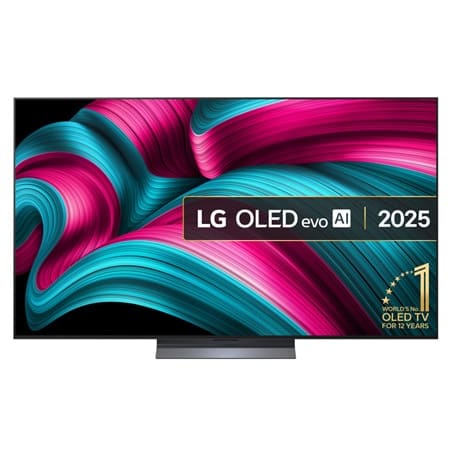
1. LG C5 65-Inch OLED (OLED65C5) — Best Overall
✅ Pros:
- Four full-bandwidth HDMI 2.1 (48Gbps) ports — every input supports 4K/120Hz, VRR and ALLM, not just two of them
- LG's α9 AI Processor Gen8 with Brightness Booster gives noticeably punchier HDR highlights than the outgoing C4 generation, at the same street price
- webOS remains the most polished, least cluttered smart platform of the three, with fast app launches and straightforward navigation
⛔ Con:
- Peak brightness, while improved, is still the weakest of the three in genuinely bright, south-facing rooms — Samsung's S85F pulls ahead on raw highlight punch
The LG C5 is the safest, most complete recommendation in this trio, and the reason is simple: it's the only one of the three with four HDMI 2.1 ports that actually all run at full 48Gbps bandwidth [2]. If you own, or plan to own, a current-generation console and a soundbar with eARC, that stops being a theoretical spec-sheet detail and becomes the difference between plugging everything in without a second thought and permanently juggling which two devices get the fast ports this month.
Picture quality is where you'd expect from LG's mainstream OLED range: perfect blacks from the self-emissive panel, genuinely improved HDR highlight brightness over the previous C4 thanks to the Gen8 processor's Brightness Booster feature [2], [3], and confident, filmic motion handling that makes it a strong all-rounder for movies, sport and everyday TV alike. Upscaling of older and lower-resolution content — still a large share of real UK viewing — is handled cleanly, without the smeared or over-sharpened look cheaper processors can produce.
Where it gives ground to the Samsung is outright brightness in a well-lit room. The C5 is a strong performer, but it isn't chasing peak nits the way Samsung's Quantum Processor-driven panel does, so a very bright, south-facing living room will show it up slightly more than the other two. That's a real trade-off, not a flaw — LG has prioritised balanced, accurate picture quality and gaming completeness over headline brightness numbers, and for most UK living rooms with normal daylight and curtains or blinds, that's the right call.
Who it's for: buyers who want one genuinely well-rounded TV without having to think hard about a specific use case — families who split time between streaming, live sport and console gaming, and anyone who values a clean, fast smart-TV interface over chasing the single brightest picture on the shelf. Who should look elsewhere: anyone in a very bright room who prioritises HDR punch above all else, or Samsung/Xbox ecosystem loyalists who specifically want the Samsung Gaming Hub's console-streaming integration — see the S85F below.
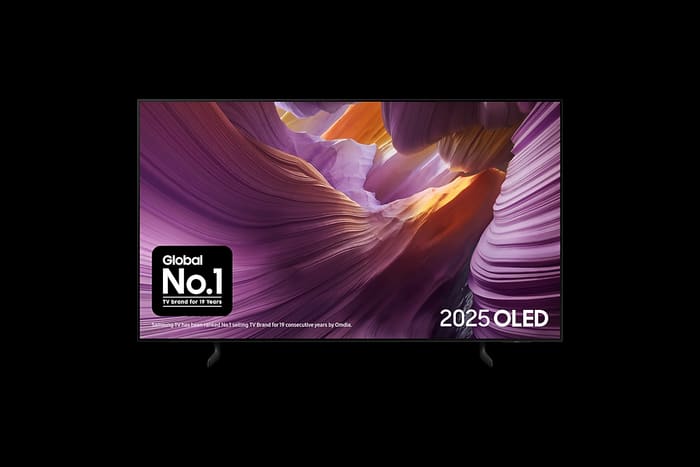
2. Samsung S85F 65-Inch OLED (QE65S85F) — Best for Brightness and Gaming
✅ Pros:
- Claimed 1,300-nit peak brightness gives it the punchiest HDR highlights of the three, genuinely useful in brighter rooms
- Four HDMI 2.1 ports supporting 4K at up to 144Hz, FreeSync Premium and Nvidia G-Sync compatibility, plus an ultra-low ~9.4ms input lag — a strong all-round gaming spec sheet
- Samsung's Quantum Processor brings a genuine ~40% CPU uplift over the previous generation, visible in cleaner upscaling and faster app performance
⛔ Con:
- The single verified UK Amazon listing for this model currently sits at £1,587.80 — above this guide's £1,500 cap, and worth watching for a sale rather than assuming as your price
Worth clearing up first, because it trips up a lot of buyers reading US TV coverage online: the Samsung S85F sold in the UK uses a WOLED panel, not the QD-OLED panel Samsung fits to the 55-inch and 65-inch S85F in North America. Samsung's own UK product listing confirms the WOLED spec for this market [4]. It's still a genuinely strong panel — Samsung's own tuning gives it real brightness advantages over its price-equivalent rivals — but if you've read a glowing US review praising S85F's QD-OLED colour volume, know that the UK model you can actually buy is a different, WOLED-based panel with a different brightness and colour profile [6].
What that panel actually delivers is the brightest, punchiest HDR image of the three TVs in this guide. Samsung claims 1,300 nits peak brightness, and independent testing backs up a real jump over the outgoing S85D — HDR highlights around 750 nits look controlled and believable rather than aggressive, which is the harder trick to pull off [5]. Typical SDR brightness sits around 300 nits, so day-to-day viewing isn't dramatically brighter than its rivals, but in HDR content — the format most new streaming releases are mastered in — the extra headroom is genuinely visible.
For gaming, this is the strongest spec sheet of the three: four full HDMI 2.1 ports (so no juggling required), 4K at up to 144Hz, both FreeSync Premium and Nvidia G-Sync compatibility covering PC as well as console players, HDR10+ gaming support, and input lag low enough that competitive players won't notice a handicap [5]. The Samsung Gaming Hub also adds cloud-gaming app support directly on the TV, without a console, which neither rival offers.
The one real complication is price. Every search this guide ran against Amazon UK's live catalogue returned the same single genuine listing, consistently priced at £1,587.80 — above the £1,500 ceiling this article is built around. That's worth being upfront about rather than quietly rounding down: this is the pick to choose if brightness and gaming features matter more to you than strictly staying under £1,500, and it's the one most likely to dip under that cap during a sale event given how often Samsung TVs are discounted in the UK.
Who it's for: gamers, especially those who want maximum HDMI 2.1 port flexibility and the widest variable-refresh-rate compatibility, and anyone in a brighter room who wants the punchiest HDR image of the three. Who should look elsewhere: strict £1,500-or-under shoppers who aren't prepared to wait for a discount, and anyone who read about the US QD-OLED version expecting the same panel here.
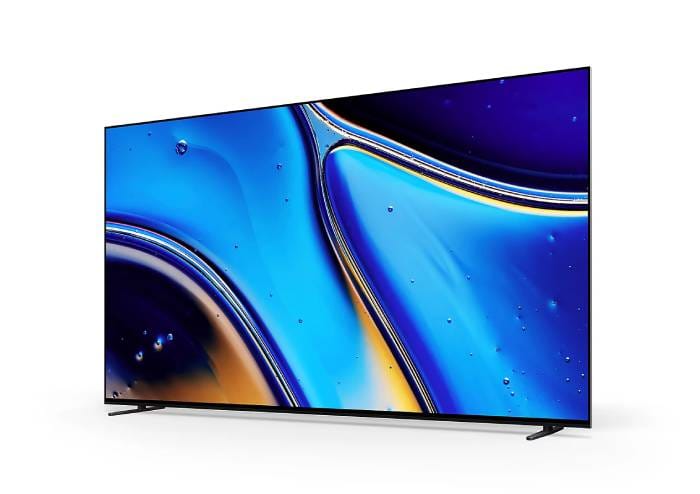
3. Sony BRAVIA 8A 65-Inch OLED (K-65XR8A) — Best for Picture Processing
✅ Pros:
- Carries the same WOLED panel and Cognitive Processor XR as Sony's standard BRAVIA 8, at a genuinely lower UK price with no picture-quality compromise
- Exceptional colour accuracy and motion handling — 99.3% coverage of the P3 colour gamut, and among the most natural, least "processed"-looking motion of any TV at this price
- Acoustic Surface Audio+ turns the screen itself into the speaker, giving noticeably more natural, dialogue-centred sound than the flat down-firing speakers in most rival TVs
⛔ Con:
- Only two of the four HDMI ports (3 and 4) actually run at full HDMI 2.1 bandwidth, and one of those doubles as the eARC connection — running a next-gen console and a soundbar at full spec simultaneously takes careful port planning
The BRAVIA 8A is a slightly unusual entry: rather than a distinct model, it's a UK-specific variant of Sony's standard BRAVIA 8, using the exact same WOLED panel and Cognitive Processor XR chip. The differences are entirely in the bundle, not the screen — a standard remote instead of a backlit one, and a shorter Sony Pictures Core streaming-credit period [10]. For a buyer who doesn't care about either of those extras, the 8A is simply the BRAVIA 8's picture quality at a genuinely lower real-world UK price, verified in stock and sold directly by Amazon at £1,499.00.
That picture quality is the reason to want a Sony at all: the Cognitive Processor XR is widely regarded as the best motion and colour processor at this price point, identifying the true source resolution of incoming content and making smarter upscaling and noise-reduction decisions than a generic processor would. The result is unusually natural, film-like motion and colour accuracy — 99.3% coverage of the P3 colour gamut in independent testing [8] — that holds up particularly well on mixed, lower-quality broadcast and older streaming content, not just pristine 4K masters. Acoustic Surface Audio+, which drives sound directly from actuators behind the screen rather than conventional downward-firing speakers, also gives noticeably clearer dialogue and more accurately placed sound than either rival manages from built-in speakers alone [9].
The real compromise is HDMI wiring, and it's worth understanding before you buy rather than after. Of the four HDMI ports, only two — HDMI 3 and 4 — run at full HDMI 2.1 bandwidth with 4K/120Hz, VRR and ALLM support [7]. The other two are standard HDMI. That wouldn't matter much on its own, except one of those two 2.1 ports also has to serve as the TV's eARC connection for a soundbar. Plug in a next-gen console on one 2.1 port and a soundbar via eARC on the other, and you've used up both — a second console, a PC or any other high-bandwidth 2.1 device has nowhere full-spec left to go. LG and Samsung's four-full-port approach avoids this problem entirely, which is the main reason the BRAVIA 8A is recommended here for picture quality specifically, not as an unconditional all-rounder.
Who it's for: film and sport viewers who prioritise natural motion, colour accuracy and built-in sound quality over chasing the highest peak-brightness number, and buyers who only need one HDMI 2.1 device connected (a single console, no separate soundbar, or a soundbar connected via optical instead of eARC). Who should look elsewhere: households running both a next-gen console and an eARC soundbar who don't want to compromise on port planning — the LG C5's four full 2.1 ports suit that setup better.
Comparison Table: LG C5 vs Samsung S85F vs Sony BRAVIA 8A
| Best for | Exact model | Key specifications | Key strength | Main limitation | Typical UK buyer |
|---|---|---|---|---|---|
| Best overall | LG C5 65-inch OLED (OLED65C5) | α9 AI Processor Gen8, 4× full HDMI 2.1 (48Gbps), 4K/144Hz, webOS | Every HDMI port is full-spec 2.1 — no gaming/soundbar compromise | Weakest peak brightness of the three in very bright rooms | Households wanting one well-rounded TV for streaming, sport and gaming |
| Best for brightness and gaming | Samsung S85F 65-inch OLED (QE65S85F) | Quantum Processor, WOLED panel (UK spec), ~1,300-nit claimed peak, 4× HDMI 2.1, 4K/144Hz, ~9.4ms input lag | Punchiest HDR highlights and the widest gaming-sync compatibility (FreeSync + G-Sync) | Verified UK price currently above the £1,500 cap | Gamers and buyers in brighter rooms who can stretch the budget slightly |
| Best for picture processing | Sony BRAVIA 8A 65-inch OLED (K-65XR8A) | Cognitive Processor XR, WOLED panel, 99.3% P3 colour gamut, Acoustic Surface Audio+, 2× full HDMI 2.1 | Most natural motion and colour handling, genuinely better built-in sound | Only 2 of 4 HDMI ports are full HDMI 2.1, and one doubles as eARC | Film and sport viewers who won't run two HDMI 2.1 devices at once |
The decisive differences come down to how each brand spent its engineering budget: LG spread its gaming capability evenly across all four ports, Samsung chased outright brightness and the broadest gaming-sync support, and Sony concentrated everything into processing and audio while trimming HDMI 2.1 to two ports. None of the three is a weak TV — the choice is genuinely about which trade-off matches your room and your setup.
What to Consider Before Buying a 65-Inch OLED TV
- Live price verification matters more than usual here. Every price quoted in this guide came from a real, checked Amazon UK listing, but TV pricing shifts with stock and seller more than most electronics — always confirm the current price, seller and fulfilment method before you commit, especially for the Samsung, where availability sat at "lead time" rather than immediate dispatch at the time of writing.
- UK warranty and returns. All three carry the manufacturer's standard 12-month UK warranty as sold new; check whether your specific Amazon seller is the manufacturer, Amazon itself, or a third-party marketplace seller, since return-window and support-contact details can differ between them.
- HDMI planning before delivery, not after. If you already own a next-gen console and a soundbar, work out which ports each will use before the TV arrives — the BRAVIA 8A in particular needs this thought through, since it has only two full HDMI 2.1 ports and one covers eARC.
- Running costs. A 65-inch OLED typically draws somewhere in the range of 150–250W depending on brightness and content, noticeably more than an equivalent LED TV at high brightness, though far less than that figure during darker scenes thanks to per-pixel dimming. It's a modest but real addition to your electricity bill versus a cheaper LED set.
- Broadcast TV support. All three support Freeview Play and the newer Freely internet-TV standard, so you get UK terrestrial channels and catch-up without a separate box — worth confirming on the exact listing you buy, since regional stock variants occasionally differ.
- Wall-mounting and stand footprint. A 65-inch panel needs a wide media unit or a checked VESA wall-mount spacing; measure your space before ordering rather than assuming standard bracket compatibility.
- Previous-generation status is a feature here, not a hidden downside. Being a step behind the newest 2026 flagship is exactly why these three TVs fit a £1,500 budget at all — the panels and processors are close enough to current-flagship performance that the saving comfortably outweighs the incremental picture-quality gap.
- Picture mode affects both quality and running cost. The vivid or dynamic picture mode most TVs default to in-store is usually the least accurate and the most power-hungry; switching to a cinema, filmmaker or standard preset at home typically gives a more natural image and noticeably lower energy draw for everyday viewing.
- Energy labelling. All three are sold with a UK energy label, and a 65-inch OLED will generally sit in a less efficient band than an equivalent LED or Mini-LED set of the same size — worth a glance if running costs are a genuine factor in your decision, not just the upfront price.
Frequently Asked Questions
Is it worth buying a 2025 OLED TV instead of waiting for the newest 2026 models?
For most buyers, yes. LG's C6, Samsung's S85H/S95H and Sony's Bravia 8 II — the actual 2026-model OLEDs — all launch at £2,000 or more [11], [12], with picture-quality gains over their 2025 predecessors that are incremental rather than dramatic. Unless you specifically need a feature unique to the newest generation, the TVs in this guide deliver a very similar real-world experience for a substantially lower price.
Will an OLED TV suffer burn-in from normal UK viewing?
Realistic risk is low. Modern OLED panels, including all three here, include automatic pixel-shifting and periodic refresh routines specifically designed to prevent it, and normal mixed viewing — streaming, broadcast TV, gaming — very rarely causes visible burn-in. The risk rises mainly with many hours a day of static, high-contrast content, such as a permanently docked news channel logo or scoreboard; if that's your typical viewing, it's worth knowing, not a reason to rule out OLED entirely.
Do I need a separate soundbar with these TVs?
The Sony BRAVIA 8A's Acoustic Surface Audio+ is genuinely the best built-in sound of the three, with clearer dialogue and better sound placement than a conventional flat-panel speaker setup — for casual viewing it can reasonably stand alone. The LG and Samsung both have competent but fairly typical flat-TV speakers: fine for dialogue and everyday viewing, but lacking the bass and scale that films and games benefit from. If home cinema-style sound matters to you, budget for a soundbar regardless of which TV you choose.
Which of these three is actually best for gaming?
The Samsung S85F on pure specification — four full HDMI 2.1 ports, up to 144Hz, both FreeSync Premium and Nvidia G-Sync compatibility, and the lowest input lag of the three [5]. The LG C5 is a close second and the more flexible all-rounder, since its four HDMI 2.1 ports mean no compromise if you're also running a soundbar via eARC [2]. The Sony BRAVIA 8A is the one to be careful with for gaming specifically: only two of its four ports are full HDMI 2.1, and one of those also carries eARC [7], so a console-plus-soundbar setup needs planning that the other two don't require.
What's the difference between WOLED and QD-OLED, and does it matter for these three?
Both are self-emissive OLED technologies with the same perfect-black advantage, but they reach it differently. WOLED — used by the LG C5, the Sony BRAVIA 8A, and the actual UK version of the Samsung S85F — adds a white subpixel alongside red, green and blue to boost brightness. QD-OLED, which Samsung fits to the North American S85F and to its own flagship S95-series, uses a quantum-dot colour layer instead, generally trading a little outright brightness for wider, more saturated colour [4], [6]. For this specific trio, it matters less than it sounds: all three UK models here are WOLED, so none of the panel-technology comparisons you may have read between US QD-OLED and WOLED sets actually apply to what you can buy in this guide — the real differences between these three come down to processing, brightness tuning and port layout, covered above.
Final Verdict: Which 65-Inch OLED Should You Buy?
The LG C5 is the strongest overall pick for most UK buyers at this budget: it's the only one of the three with four fully-specified HDMI 2.1 ports, so there's no compromise between gaming and soundbar connectivity, and its picture quality and smart platform are both genuinely excellent rather than merely adequate. Choose the Samsung S85F instead if outright HDR brightness and the widest gaming-sync compatibility matter more to you than staying strictly under £1,500 — its live UK price currently sits just above the cap, so it's worth watching for a sale. Choose the Sony BRAVIA 8A if natural colour, motion and genuinely better built-in sound are your priority and you won't be running two HDMI 2.1 devices at once.
- LG C5 65-inch OLED (OLED65C5) — Best overall. 👉 Check price on Amazon UK
- Samsung S85F 65-inch OLED (QE65S85F) — Best for brightness and gaming. 👉 Check price on Amazon UK
- Sony BRAVIA 8A 65-inch OLED (K-65XR8A) — Best for picture processing. 👉 Check price on Amazon UK
Whichever you choose, verify the live price, seller and delivery timeframe on Amazon UK before ordering — all three of these listings move with stock, and a genuine sale can shift which one offers the best value on the day you buy.
By ChoiceWise