Best Freely TVs UK 2026 – Stream Live Channels Without an Aerial
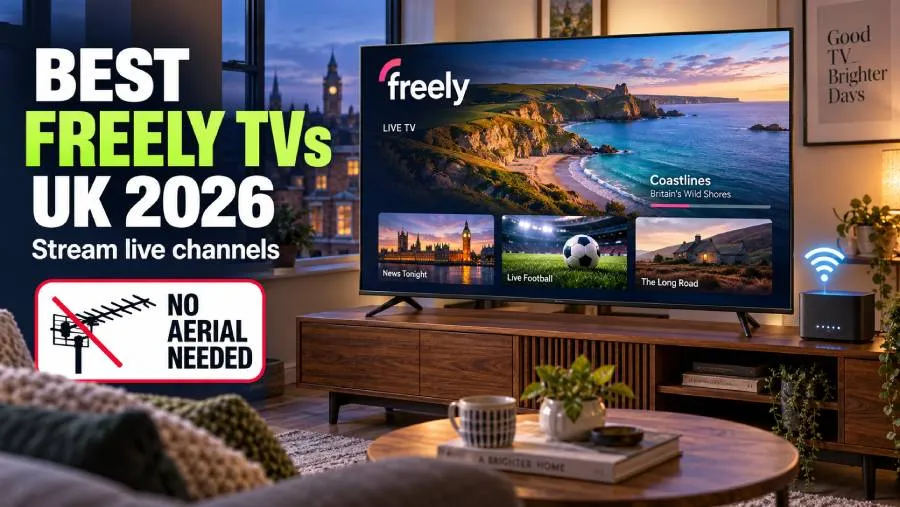
Freely puts live BBC, ITV, Channel 4 and Channel 5 channels on your television over your home broadband — no aerial, no dish and no set-top box [1]. Updated for 2026, this guide picks the four Freely TVs worth buying in the UK right now, from a £289 55-inch to a gaming-grade 65-inch.
- TCL 55PF650K — the cheapest of the four. 👉 Check price on Amazon UK
- Hisense 55E6QTUK — the best all-rounder under £350. 👉 Check price on Amazon UK
- Panasonic TV-65W85BEY — the best picture processing and sound for a main living-room set. 👉 Check price on Amazon UK
- Hisense 65U7STUK — the one to buy if you also game. 👉 Check price at Hughes
👉 One thing the marketing tends to skip: all four of these sets still work with an aerial plugged in. Freely adds a second route to live television; it does not remove the old one. The reviews below explain which set suits your room, your broadband and your budget.
What a Freely TV does, and who should buy one in 2026
Plenty of UK homes have the same awkward problem. The flat has no aerial socket in the living room. The roof aerial is thirty years old and drops out whenever it rains. The spare bedroom has power and Wi-Fi but no coaxial cable anywhere near it. Until recently the answer was an aerial installer, a satellite dish or a monthly subscription.
Freely is the broadcasters' own answer to that. Built by Everyone TV — the BBC, ITV, Channel 4 and Channel 5 joint venture — it streams live channels and on-demand players over your broadband, through one guide, at no extra cost beyond the television itself [1]. Press the Freely button and you get a live channel list rather than a wall of apps.
The catch is that the Freely badge tells you nothing about the television wrapped around it, which is why the best Freely TV for an aerial-free home is rarely the one with the most Freely marketing on the box. That part is what the rest of this guide sorts out.
The specs that separate a good Freely TV from a bad one
Freely certification is binary — a set either has it or it does not. Everything that separates a good Freely TV from a merely adequate one sits elsewhere. These are the criteria that matter, in the order they will affect you.
- Broadband headroom. Freely asks for a minimum of 10Mbps to stream live channels and on-demand content [3].
- How much of the channel list you will see. Freely's published line-up runs to roughly 240 channel slots, but 89 of those carry an asterisk marking them as delivered through an aerial rather than over broadband [2].
- Panel brightness and reflection handling, which decide whether daytime viewing works in your room.
- The smart platform — VIDAA or Fire TV — because that is the interface you live in when you are not watching live channels.
- Gaming features, if a console is ever plugged in.
- Sound, because a thin-panel television with two small drivers will send you soundbar shopping within a month.
- Running cost, which the EU energy label states plainly.
That channel-list point deserves unpacking, because it is the most misunderstood thing about Freely. The service is aerial-free in the way it claims: you can unbox the television, connect Wi-Fi and watch BBC One, ITV1, Channel 4 and Channel 5 live without any cable in the aerial socket. But the fuller line-up you see advertised is a combined figure. Channels such as Sky Mix, Sky Arts, Challenge, E4 Extra and the Great! network are marked on Freely's own list as arriving through an aerial, and Freely notes that aerial availability varies by transmitter and region [2][4]. Plug an aerial in and those appear alongside the streamed channels in the same guide; leave it out and you keep roughly 151 slots, including every main public-service channel and the BBC radio stations.
That is the trade a Freely buyer is making, and it is a reasonable one. What you lose against a working roof aerial is the long tail of smaller free-to-air channels. What you lose against a Sky or streaming subscription is premium sport and film channels, which Freely does not carry at all. What you gain is live television in any room with a plug and a Wi-Fi signal, with no contract, no installer and no monthly bill.
The smart platform matters more than buyers expect. On a Hisense set Freely sits inside VIDAA; on a Fire TV set it sits alongside Amazon's own live-television row. Both work, but they feel different, and the remote you press twenty times an evening is worth caring about. Brightness matters for a different reason: every set here is an edge-lit or direct-lit LCD rather than an OLED, so a bright bay window is a real constraint on where the television can go.
One option worth knowing about before you commit to a new set: Freely-certified streaming devices — Netgem's PLEIO and Manhattan's Aero — plug into an existing television's HDMI port and add the same guide over Wi-Fi [19]. If the television you own is otherwise fine and the only problem is the missing aerial, that is the cheaper fix. Buying a Freely television makes sense when you were replacing the set anyway, or when you want the Freely button on the remote rather than an extra box and a second remote to lose down the sofa.
Top 4 Freely TVs worth buying – UK 2026
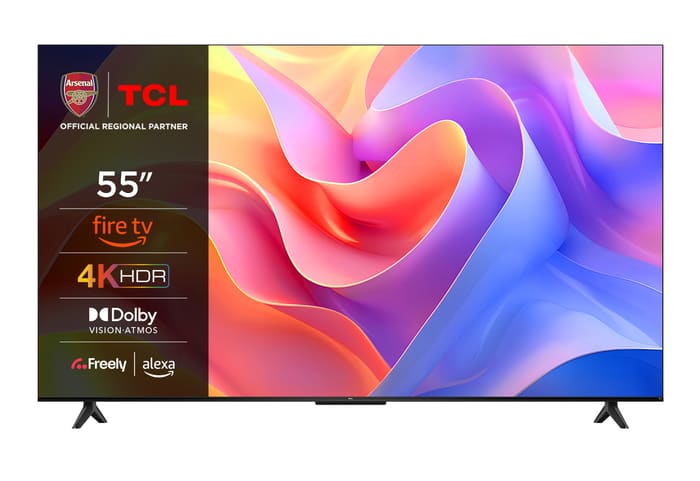
1. TCL 55PF650K — one of the cheapest ways into Freely at 55 inches
✅ Pros:
- Among the cheapest 55-inch sets on Freely's list at £289; only two Bush models undercut it, by £10 [8][17]
- Dolby Vision, HDR10 and HLG support on a television this cheap [7]
- Fire TV built in, with Alexa voice search through the bundled remote [7]
⛔ Con:
- A 2024-generation panel with a 60Hz refresh rate, so it has nothing to offer a console owner [7]
This is the set to buy when the priority is a big screen with live channels for the least money. TCL lists the PF650K as a 2024 model year and it has stayed in the range since, which is why it now sits near the bottom of the Freely price list [7][17]. The QLED TCL TC6 is the Freely-certified step-up, on Freely's list at £379 in the 55-inch size [17].
The standout is Dolby Vision. Dynamic HDR metadata on a £289 television is not something to take for granted, and on the streaming players that dominate Freely viewing — iPlayer, ITVX, Channel 4 — it makes a visible difference to contrast in darker drama. TCL pairs it with HDR10 and HLG, the format broadcasters use for live HDR [7].
Fire TV is the other half of the proposition, and it creates an interesting overlap. Amazon's platform already builds live broadcast channels into its home screen, but TCL's own documentation is explicit that this feature needs a TV aerial [7]. Freely is what fills that gap over Wi-Fi. If you have no aerial, Freely is the live-TV layer on this television, not a duplicate of one.
TCL has not skimped on the parts that cost nothing to include. There is HDMI 2.1 with ALLM, so a console that is plugged in will at least trigger low-latency mode automatically, and TCL's Game Master feature set is present. The cabinet is a bezel-less metal design rather than the moulded plastic frame this money usually buys, and the set carries a two-year warranty as standard [7]. Standby draw is 0.5W [9].
The compromises are where you would expect them at this price. The panel runs at 60Hz, and the EU energy label puts it in class F for standard content, drawing 70W, and class G for HDR at 95W [9]. Neither figure is alarming for a 55-inch set, but it is the least efficient of the four relative to its size. Dolby Atmos decoding is listed, but it feeds a basic 2 × 10W stereo pair, so the sound suits news and daytime television rather than film nights [7]. It is also worth being clear about what a 2024-generation panel means in practice: fast motion in sport will smear more than it does on the Hisense sets, and off-angle viewing falls away quickly, so this is a television to sit in front of rather than beside.
Best for: a second living room, a rental, a student flat, or anyone furnishing a room where the television needs to be cheap and the aerial socket does not exist. Avoid it if you game, or if this is the main set in a bright room — brightness and motion handling are the first things that give way at this price.
The practical compromise is straightforward: you accept a 2024 panel and basic motion handling in exchange for one of the lowest entry prices to Freely at this screen size.
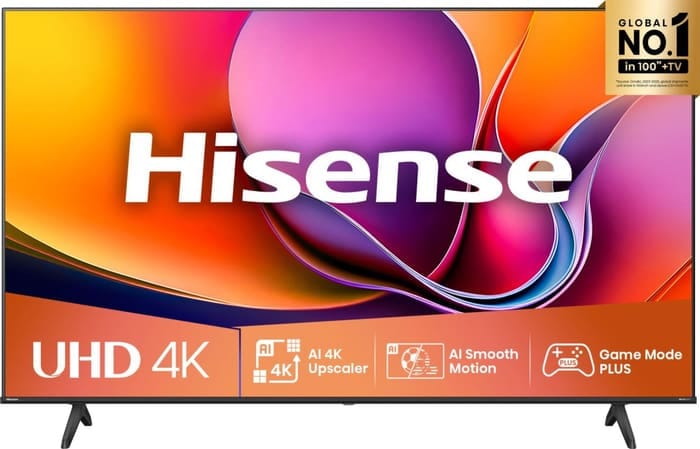
2. Hisense 55E6QTUK — the best all-rounder under £350
✅ Pros:
- Dolby Vision plus three HDMI 2.1 ports with ALLM and VRR, unusual at the £319 Freely list price [10][11]
- Lower running costs than the TCL — class E and 64W for standard content [12]
- Light enough at 11kg with its stand to move or wall-mount single-handed [10]
⛔ Con:
- No Dolby Atmos and only 2 × 10W of built-in sound, the weakest audio here [10]
Thirty pounds more than the TCL buys a noticeably better-specified television, and this is the pick most people should take if the budget stretches. Hisense's 2026 replacement, the 55E6STUK, is not on Freely's device list — if Freely is the point, it has to be the E6Q [17].
The connectivity is the surprise. Hisense gives all three HDMI ports the 2.1 label with ALLM and VRR at 60Hz, and quotes input lag of 20ms or under in game mode [10]. That will not satisfy anyone chasing 120Hz, but it means a PS5 or Series S plugged into this set behaves properly rather than fighting the television. Dolby Vision, HLG and HDR support are all present, and Hisense rates native contrast at 4000:1 with an 8ms panel response time [10].
Be clear about what is missing, though. Hisense lists no local dimming and no wide colour gamut on this model [10], which is the difference between a competent budget panel and a mid-range one: highlights will not punch the way they do on the Panasonic, and very dark scenes show the grey wash typical of an edge-lit LCD. AirPlay 2 is supported, which matters if the household runs iPhones, and the set peaks at 130W in use [10].
It is also the most economical of the four in relative terms. The EU energy label records class E and 64W for standard content, and class G at 100W for HDR [12]. Over a few hours a day that is a few pounds a year rather than tens, but it is the sort of difference that compounds on a set left on for daytime television.
VIDAA is the platform, and it is the cleaner experience for a Freely-first household. The Freely button drops you straight into the live guide, and VIDAA does not push a shopping row at you the way Fire TV can. The trade is a smaller app catalogue than Amazon's, though every major UK player is present.
Sound is the clear weak point. Two 10W drivers with DTS Virtual X and no Dolby Atmos decoding is basic, and dialogue in film soundtracks will have you reaching for subtitles. Budget for a soundbar if this is the main television.
Best for: the main television in a normal-sized UK living room, on a budget, with occasional gaming. Avoid it if sound quality matters more to you than picture, or if the room is very bright.
The compromise here is audio: you take class-leading connectivity for the money and accept that a soundbar is not optional.
If the Best all-rounder under £350 category has you leaning towards a Freely-ready 55-inch 4K set, the Hisense 55E6QTUK with Freely offers the most direct fit on its ChoiceWise page.
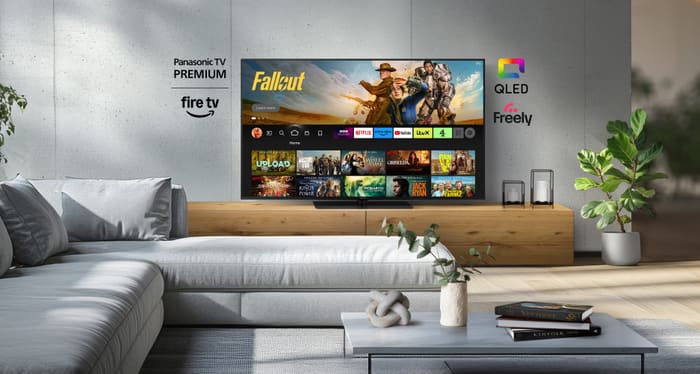
3. Panasonic TV-65W85BEY — the best picture processing and sound for a main living-room set
✅ Pros:
- A 120Hz QLED panel with Panasonic's HCX processor, the strongest picture engine here [13]
- Every major HDR format — HDR10+, HDR10, HLG and Dolby Vision — plus Filmmaker Mode [13]
- 24W of stereo output backed by a 12W woofer and Dolby Atmos decoding [13]
⛔ Con:
- Only three HDMI inputs, and just two of them carry VRR [13]
This is the one to buy if the television is the centrepiece of the room rather than a utility.
Panasonic's reputation rests on picture processing, and the HCX processor is the reason to pay the £849 Freely list price rather than £319 [14]. It is paired with a 120Hz QLED panel and full HDR format support — crucially, both HDR10+ and Dolby Vision, where most televisions back only one of the two [13]. Filmmaker Mode is included, which disables the motion smoothing and sharpening that make films look like soap operas.
Panasonic lists Freely in its own specification sheet [13], and Freely's own line, carried on Panasonic's product page, is the clearest summary of the proposition: “No dish, no box, no need for an aerial – all you need is Wi-Fi” [18]. The smart platform is Fire TV, in Panasonic's own Premium implementation, with Alexa through the remote, AirPlay and Apple Home.
Gaming is better served than the price tier suggests. Game Mode Extreme includes a Game Control Board overlay, ALLM works on every input and VRR runs up to 120Hz [13]. The limitation is port count: three HDMI inputs, one of which is the eARC port for a soundbar, and VRR on only two of them. A household with a console, a streaming box and a soundbar will be unplugging things.
Sound is the best of the four by a wide margin — 12W per channel plus a 12W woofer, with Dolby Atmos and Panasonic's Surround Sound Pro [13]. It will not replace a dedicated system, but it is the only set here that does not demand one.
For live television specifically, this is also the best-equipped set in the guide. Alongside Freely it carries a DVB-T/T2, DVB-S2 and DVB-C tuner, HbbTV 2.0.4 for broadcast interactive services, and a CI Plus 1.4 common interface slot for a viewing card — so it can take a satellite or cable feed as well as an aerial [13]. There is no twin tuner and no USB recording, so recording live broadcasts is not an option on this model. Standby draw is under 0.5W, and the picture modes include Dynamic, Normal, Cinema, True Cinema, Filmmaker, Sport and Game [13].
Best for: a main living room where films and drama are the priority and picture quality justifies the spend. Avoid it if you need more than three HDMI inputs, or if 65 inches is too large for the viewing distance.
The compromise is connectivity rather than picture: you get the best picture processing and sound here, on a set that is slightly mean with its inputs.
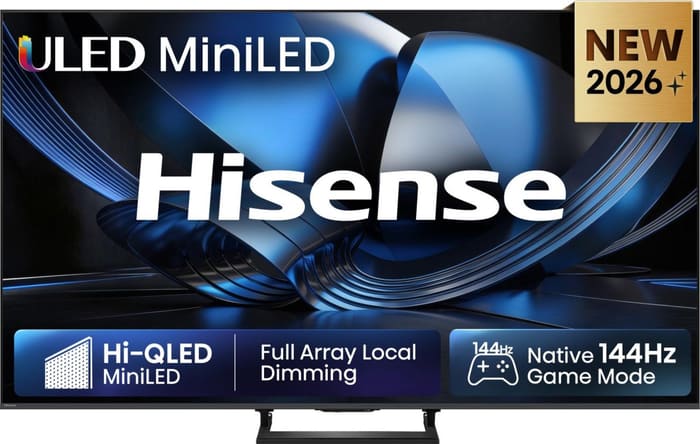
4. Hisense 65U7STUK — the one to buy if you also game
✅ Pros:
- VRR up to 144Hz on HDMI 3 and 4, and input lag of 4ms or under at 4K 120Hz [15]
- Mini-LED backlight with full-array local dimming, plus Dolby Vision IQ, Dolby Vision Gaming and HDR10+ gaming support [15][16]
- A built-in subwoofer alongside 2 × 10W drivers, with Dolby Atmos [15]
⛔ Con:
- By far the most expensive set here at £1,199, and the gaming features are wasted without a console [16]
This is the newest television in the guide and the only one built with a games console in mind.
The numbers that matter are the gaming ones. Hisense quotes input lag of 4ms or under with a 4K 120Hz input, and HDMI 3 and 4 carry VRR at up to 144Hz [15]. For comparison, the 55E6QTUK earlier in this guide quotes 20ms or under. Dolby Vision Gaming and HDR10+ gaming are both supported, which means HDR works properly in games rather than being switched off in game mode as it is on cheaper sets.
It is not a one-trick television. The panel is Mini-LED with full-array local dimming, so it holds bright highlights beside deep blacks as the two 55-inch sets cannot [15][16]. Dolby Vision IQ adjusts HDR tone mapping to the light in your room, which is the feature that most helps a set used in daytime as well as evening. Sound is the second-best here: two 10W drivers plus a dedicated subwoofer with Dolby Atmos decoding, which gives film soundtracks a low end the two 55-inch sets cannot produce [15].
This model is on Freely's own device list at £1,199 [16]. Like the others it runs VIDAA, and like the others it keeps a full DVB-T2, DVB-C and DVB-S2 tuner with two RF tuners, so an aerial or satellite feed remains an option [15].
Running costs sit where you would expect for a 65-inch set with this much backlight to drive: class E for standard content and class G for HDR, peaking at 240W in use, with 0.5W in standby [15]. There is a USB 3.0 port alongside the USB 2.0 one, useful for media playback from a drive, and AirPlay 2 is supported as on the cheaper Hisense [15].
The obvious objection is price. At £1,199 this costs more than the other three combined, and a buyer who only wants aerial-free live television is paying for a great deal they will never use. Put next to the Panasonic, which costs £350 less, the trade is clear enough: the Panasonic has the better picture processing and the better sound, the Hisense has the Mini-LED backlight and the gaming specification. The gaming specification is the justification, and without a console it is hard to make the sums work.
Best for: a household with a PS5, Xbox Series X or gaming PC that also wants live television without an aerial. Avoid it if nobody games — the 55E6QTUK or the Panasonic deliver far more picture per pound.
The compromise is cost: you pay a premium for gaming headroom that only pays back if it is used.
If you’re gaming as much as you’re watching, the Hisense 65U7STUK is the Freely TV pick that keeps latency low — see the Hisense 65U7STUK on its ChoiceWise page.
Comparison table
| Best for | Exact model | Key specifications | Key strength | Main limitation | Typical UK buyer |
|---|---|---|---|---|---|
| Lowest price | TCL 55PF650K | 55in, 4K, 60Hz, Fire TV, Dolby Vision, class F / 70W | One of the cheapest routes to Freely at 55in | 2024 panel, no gaming features | Renter or second-room buyer |
| Best all-rounder | Hisense 55E6QTUK | 55in, 4K, 60Hz, VIDAA, 3 × HDMI 2.1 ALLM/VRR, class E / 64W | Connectivity and efficiency for the money | 2 × 10W sound, no Atmos | Main living room on a budget |
| Best processing and sound | Panasonic TV-65W85BEY | 65in, 4K QLED, 120Hz, Fire TV, HDR10+ and Dolby Vision, 24W + 12W woofer | HCX processing and the best built-in sound | Only 3 HDMI, VRR on 2 | Film-first living room |
| Best for gaming | Hisense 65U7STUK | 65in, 4K Mini-LED with full-array local dimming, VRR to 144Hz, 4ms lag, VIDAA, Dolby Vision IQ, subwoofer | Console performance and HDR gaming | £1,199 — dearest by far | Console household |
The decisive split is between the two 55-inch sets and the two 65-inch ones. Under £350 you are choosing between the TCL's lower price and the Hisense's better ports and lower running costs — the Hisense wins that on points for £30. Above £800 you are choosing between processing and backlight: the Panasonic for picture processing and sound, the Hisense 65U7STUK for Mini-LED and consoles.
- TCL 55PF650K — 👉 Check price on Amazon UK
- Hisense 55E6QTUK — 👉 Check price on Amazon UK
- Panasonic TV-65W85BEY — 👉 Check price on Amazon UK
- Hisense 65U7STUK — 👉 Check price at Hughes
What to consider before buying
The specification sheet is only half the decision. These are the ownership questions that decide whether a Freely TV works in your home.
- Check your broadband first. Freely states a 10Mbps minimum for live streaming and on-demand content [3]. That is a low bar for fibre, but a shared household streaming in two rooms while somebody works from home needs more headroom than the number suggests.
- Decide whether you will plug an aerial in. If your home has a working aerial socket, connecting it costs nothing and adds the aerial-delivered channels to the same guide [4]. If it does not, you are choosing the streamed line-up, which is a reason to check Freely's channel list for anything you watch regularly before you buy [2].
- Budget for the TV Licence. Freely costs nothing beyond the television, but a licence is still legally required to watch or record live television on any channel or service, and to use BBC iPlayer. It costs £180 a year [6].
- Check the live seller and price at the point of purchase. Prices quoted are Freely's published list prices at the time of writing (September 2026). Prices at this end of the market move quickly, and stock, warranty terms and returns are worth confirming on the listing rather than assuming.
- Factor in a soundbar for the 55-inch sets. The Hisense 55E6QTUK has no Dolby Atmos decoding, and both it and the TCL rely on a pair of 10W drivers [7][10].
- Consider running costs over the life of the set. The energy classes here range from E to G depending on content type, and HDR viewing roughly doubles power draw on every one of these televisions [9][12].
- Think about platform longevity. Fire TV and VIDAA are both actively maintained, but the app you care about in five years may not be the app you care about today. An HDMI port kept free for a streaming stick is cheap insurance.
- Check the weight and mounting. The 55E6QTUK is 11kg with its stand; 75-inch sets in the same family are nearly three times that. Wall-mounting a large television is a two-person job.
One more thing worth saying plainly: none of these televisions is aerial-free in the sense of lacking a tuner. All four still take an aerial feed — three list full DVB-T2 tuners, and TCL's page says Fire TV's live-broadcast row needs a TV aerial — so if you move to a house with a good aerial, nothing is wasted [7][10][13][15]. Freely gives you the option of ignoring the aerial socket, not the obligation.
If your shortlist is really about price rather than Freely specifically, our guide to the best 4K smart TVs under £500 covers the wider budget market, including sets without Freely.
Frequently asked questions
Which is the best Freely TV if I have no aerial at all?
For most aerial-free homes it is the Hisense 55E6QTUK: at £319 its ports, running costs and VIDAA guide make Freely the main way you watch; console households should take the Hisense 65U7STUK instead. Neither needs an aerial. Freely delivers live channels over your home broadband, and the service is designed to work with nothing plugged into the aerial socket [1][3]. You need mains power, a Wi-Fi or Ethernet connection of at least 10Mbps, and a TV Licence. An aerial remains optional: Freely's own guidance is that if your television has an aerial port and a working aerial, you can include those channels in the same guide, and the line-up you receive will depend on your transmitter and region [4].
Does Freely replace Freeview, or sit alongside it?
It sits alongside it. Freeview travels over the air from a transmitter to an aerial; Freely travels over your broadband. On every television in this guide both routes exist at once: three keep a full DVB-T2 tuner, and the TCL's live-broadcast row needs a TV aerial [7][10][13][15]. In practice, an aerial-free home sees the streamed line-up only — around 151 of the roughly 240 slots on Freely's published list, including every main public-service channel — while an aerial-connected home sees those plus the 89 slots Freely marks as aerial-delivered [2].
Do I still need a TV Licence if I only watch Freely?
Yes. A TV Licence is required to watch or record live television on any channel or service, and to use BBC iPlayer, regardless of how the signal reaches you [6]. Freely's own guidance says the same [5]. The licence costs £180 a year, and once it is paid there is nothing further to pay for Freely itself — no subscription and no contract.
Will Freely work on poor or capped broadband?
Freely asks for at least 10Mbps for live channels and on-demand content [3]. A standard fibre connection clears that comfortably, but two considerations catch people out. First, the figure applies per stream, so two televisions watching at once need roughly twice the headroom. Second, streamed live television consumes data continuously in a way aerial broadcast does not — on a capped or mobile broadband connection, several hours of daily viewing adds up quickly. If your connection is unreliable, an aerial is the more dependable route for live channels.
Final verdict
The Hisense 55E6QTUK is the strongest overall pick. At £319 it delivers three HDMI 2.1 ports with ALLM and VRR, Dolby Vision, and the lowest running costs here — a combination nothing else at this price matches, and enough television for most UK living rooms.
- TCL 55PF650K — the cheapest of the four. 👉 Check price on Amazon UK
- Hisense 55E6QTUK — the best all-rounder under £350. 👉 Check price on Amazon UK
- Panasonic TV-65W85BEY — the best picture processing and sound for a main living-room set. 👉 Check price on Amazon UK
- Hisense 65U7STUK — the one to buy if you also game. 👉 Check price at Hughes
Choose the TCL 55PF650K if the budget is fixed and screen size is the point. Choose the Panasonic TV-65W85BEY if films and drama are what the television is for — the HCX processor and the woofer-backed sound justify the step up. Choose the Hisense 65U7STUK only if a console is part of the household, because that is what the extra spend buys.
Whichever you pick, check the channel list against what you watch before ordering, and confirm the current price and seller on the listing — the sub-£350 end of this market moves week to week.
By ChoiceWise